Filipinos in South Korea
Showing posts with label China. Show all posts

Global Research Pointed: USA, Loida Lewis and Liberal party behind the ISIS attack in the Philippines

 Global Research Pointed: USA, Loida Lewis and Liberal party behind the ISIS attack in the Philippines
GlobalReaseach.ca pointed out who are behind the Islamist terrorist attack in Marawi City in Southern Philippines

In the article written by Stephen Lendman lives in Chicago, USA, he pointed that Washington, Loida Lewis and the Liberal Opposition party in the Philippines are behind the IS attack in Marawi a step to oust Duterte

Why is ISIS Operating in the Philippines?

In response to violence allegedly instigated by ISIS in the Philippines, President Rodrigo Duterte declared martial law in Mindanao, imposed military rule, and threatened to extend it nationwide to defeat the threat.

What’s going on? Why did ISIS begin operating in the Philippines? Weeks after taking office in mid-2016, Duterte blasted Western imperial Middle East policies, saying the Obama administration and Britain “destroyed the (region)…forc(ing) their way into Iraq and kill(ing) Saddam.”

“Look at Iraq now. Look what happened to Libya. Look what happened to Syria.”

He blasted former UN Secretary-General Ban Ki-moon for failing to act responsibly against what’s gone on for years – on the phony pretext of humanitarian intervention and democracy building.

He called Obama a “son-of-a-bitch” for his unaccountable actions – no way to make friends in Washington, especially if his geopolitical agenda conflicts with US aims.

Philippine President Rodrigo Roa Duterte meeting with Russian President Putin
Philippine President Rodrigo Roa Duterte meeting with Russian President Putin. Duterte cuts short trip to Russia after declaring martial law in southern Philippines due to Islamist terrorism attack in Marawi City. Photo: Japanese Times

On the day he declared martial law, he met with Vladimir Putin in Moscow for discussions on future military and economic cooperation.

He seeks improved economic and military ties with China. Ahead of visiting Beijing last October, he said

“only China…can help us,” adding:

“All that I would need to do is just to talk and get a firm handshake from the officials and say that we are Filipinos and we are ready to cooperate with you, to help us in building our economy and building our country.”

“If we can have the things you have given to other countries by the way of assistance, we’d also like to be a part of it and to be a part of the greater plans of China about the whole of Asia, particularly Southeast Asia.”

He promised to cool tensions over South China Sea disputes.

“There is no sense fighting over a body of water,” he said.

“We want to talk about friendship (with Beijing). We want to talk about cooperation, and most of all, we want to talk about business. War would lead us to nowhere.”

He announced no further joint military exercises with America, saying he’s open to holding them with China and Russia.

Shifting away from longstanding US ties doesn’t go down well in Washington. Are efforts by ISIS to establish a Philippines foothold part of an anti-Duterte Trump administration or CIA plot independent of his authority?

Null
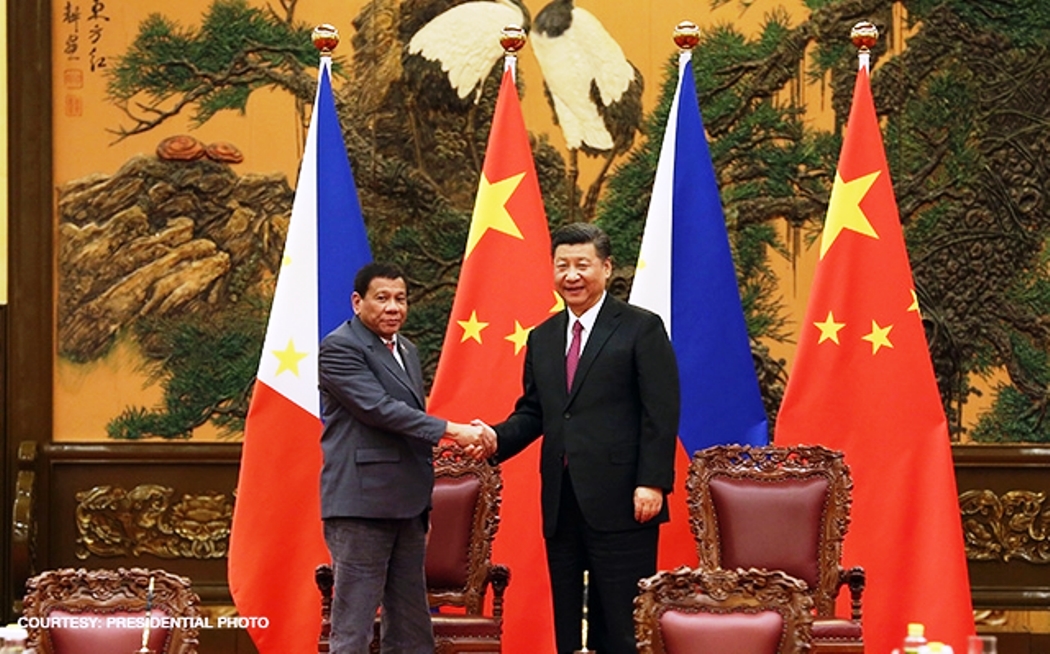
Philippine President Rodeigo Roa Duterte meeting with Chinese President Xi Jinping cooling down the tension in South China Sea and promised cooperation, progress, peace and stability of the Asian Region.

According to a June 2 Duran.com report, retired Philippine military official Abe Purugganan claims ISIS violence in Mindanao is part of an opposition Liberal Party plan to undermine Duterte and oust him from office – citing information from a party whistleblower.

Below are the comments The Duran posted, saying:

“There is a lot of noises and chatters flooding the cyberspace, you got to use your discernment to filter all these information.”

“LETS PLAY FIRE WITH FIRE,” explaining “(t)hese are the exact words stated by Loida Lewis and her fellow oligarchs on a meeting months ago with Liberal Party members abroad,” adding:

Their plan is to use ISIS or ISIS-connected terrorists to instigate violence and chaos in Mindanao, wanting Duterte’s government destabilized and ousted.

If the information reported is accurate, it explains what’s now going on, likely to worsen, perhaps spread to other parts of the country.

Last week, Duterte said

“if I cannot confront (ISIS terrorists threatening the country), I will resign. “If I am incompetent and incapable of keeping order in this country, let me step down and give the job to somebody else.”

If US dirty hands are behind the ISIS insurgency, he’s got a long struggle ahead, trying to overcome the attack on him and perhaps Philippine sovereignty.

Stephen Lendman lives in Chicago. He can be reached at lendmanstephen@sbcglobal.net.
His new book as editor and contributor is titled “Flashpoint in Ukraine: How the US Drive for Hegemony Risks WW III.”

http://www.claritypress.com/LendmanIII.html

Visit his blog site at sjlendman.blogspot.com.

The original source of this article is Global Research
Copyright © Stephen Lendman, Global Research, 2017

How America Failed the Philippines?

Washington pushed the Philippines away by failing to honor moral, if not legal, obligations to its long-standing ally
Washington pushed the Philippines away by failing to honor moral, if not legal, obligations to its long-standing ally.

“As published by the National Interest -  said Philippine president Rodrigo Duterte in October to his Chinese hosts, referring to America. “So I will be dependent on you for a long time.”

Within months of taking office, Duterte had accomplished the inconceivable, reorienting his country away from its only protector, the United States, and toward its only adversary, China. It is China that grabbed Mischief Reef from Manila in the first half of the 1990s and seized Scarborough Shoal in early 2012. The United States is the only nation pledged to defend the territorial integrity of the Philippines.

Some in the Washington policy community, upset with the flagrant display of disloyalty of the Philippine leader, said it was time to end the mutual-defense treaty with Manila. Yet the fundamental issue is not the firebrand Duterte. The issue is Washington. Washington did much to push Duterte away by failing to honor moral, if not legal, obligations to its long-standing ally. The Philippine president did not have to provoke America as he did in October during his trip to Beijing. But his words, though extreme, were nonetheless a predictable outcome of a misguided U.S. policy. It is unlikely that Duterte is spouting off against Washington to get a better deal, playing the Americans off the Chinese and Russians.

His many outbursts against the United States, in fact, look genuine, rooted in a century of Philippine nationalism and mistrust. Duterte was schooled in anti-Americanism from an early age. His grandmother, a Muslim, taught him that the United States was guilty of grave crimes during its colonization of the Philippines. To this day, he refers to the 1906 massacre of the Muslim Moros and believes Washington has not atoned for this particular instance of brutality or, more generally, the torture of Filipinos and the subjugation of his country. To make matters worse, Duterte then learned politics in university in the 1960s from Jose Maria Sison, the founder of the Communist Party of the Philippines. The president now proudly calls himself a leftist.

All these factors mean that America, in Duterte’s eyes, can never do anything right. He still rails about being denied a U.S. visa early last decade. Moreover, he won’t stop talking about what he perceives to be a violation of Philippine sovereignty, the mysterious disappearance of “treasure hunter” Michael Meiring from Davao City in May 2002 after the detonation of a bomb in his hotel room. Duterte, the mayor of that city at the time, believes that Meiring was whisked out of the country by the Central Intelligence Agency.

So not too many Filipinos were taken aback when Duterte slung a homophobic slur at then ambassador Philip Goldberg in August and, by some accounts, directed an equally derogatory comment in the direction of President Barack Obama the following month. As a close aide to Duterte characterized his virulent anti-Americanism, “It’s policy, personal, historical, ideological, et cetera, combined.”

Although Duterte’s views appear warped by prejudice, he nonetheless has good reason to complain about Washington, which despite its mutual-defense pact has not protected his country adequately. Manila has unsuccessfully attempted, since at least the late 1980s, to compel the United States to confirm that the treaty, signed in 1951 and ratified the following year, covers the reefs, rocks, shoals, atolls and islets Manila claims—and China covets—in the West Philippine Sea.

 BEIJING, WHICH calls that expanse by its more common name, the South China Sea, claims the same features. Its official maps contain nine, and sometimes ten, dashes forming an area called the “cow’s tongue.” Inside the tongue-shaped area is about 85 percent of that critical body of water, and Beijing claims sovereignty over every feature there. Moreover, official Chinese state media has recently used language directly suggesting that all the waters inside the dashes are sovereign as well. Beijing now has a term for all this: “blue national soil.”

The United States does not take sides on the many South China Sea territorial disputes—China’s claims also conflict with those of Taiwan, Malaysia, Brunei, Indonesia and Vietnam—but Washington does insist on peaceful resolution. Beijing’s actions, however, have been anything but peaceful. For instance, it seized Mischief Reef in a series of acts beginning in 1994. The feature is far closer to the Philippines than other claimants—Hanoi and Taipei as well as Beijing—but Washington did nothing to reverse the Chinese action. American policymakers at the time adopted a serves-them-right attitude because Manila, gripped by one of its bouts of nationalistic fervor, had just ejected the U.S. Navy from its facilities in Subic Bay and the U.S. Air Force from the nearby Clark Air Base.

In early 2012, China moved again. After the Philippines detained Chinese poachers taking endangered coral, giant clams, sea turtles and baby sharks around Scarborough Shoal, Chinese vessels swarmed the feature, which sits only 124 nautical miles from the main Philippine island of Luzon and about 550 nautical miles from China. The shoal—just rocks above the waterline—is strategic because it guards the mouths to Manila and Subic Bays.

China at the strategic speck employed its “cabbage strategy.” By wrapping the shoal “layer by layer like a cabbage” with small vessels, Maj. Gen. Zhang Zhaozhong explained, Beijing could exclude others. In June of that year, Washington brokered an agreement for both sides to withdraw their craft, but only Manila complied. Beijing has been in firm control of the feature since then.

Washington policymakers, despite the seizure, decided to let the matter drop. As Doug Bandow of the Cato Institute suggested, no American president could convince the public to defend “uninhabited rocks of no intrinsic importance.” And as a “senior U.S. military official” told the Washington Post in 2012,

I don’t think that we’d allow the U.S. to get dragged into a conflict over fish or over a rock. Having allies that we have defense treaties with, not allowing them to drag us into a situation over a rock dispute, is something I think we’re pretty all well-aligned on.

In short, the United States did nothing to hold China accountable for its deception. By doing nothing, however, America empowered the most belligerent elements in the Chinese political system by showing everybody else in Beijing that aggression works.

Months after taking control of Scarborough, an emboldened Beijing pressed forward by rapidly stepping up incursions around the Senkaku Islands in the East China Sea, claimed by China but under the control of Japan. And Beijing continued to apply pressure in the South China Sea, especially at Second Thomas Shoal, like Scarborough, thought to be part of the Philippines. At Second Thomas, Manila in 1999 grounded the Sierra Madre, a World War II–era hospital ship, to mark the shoal, and left a handful of marines on board. China, once again employing cabbage tactics, used small craft to surround the tiny Philippine garrison. In March 2014, Chinese craft escalated by turning back two of Manila’s resupply vessels, cutting off the troops stationed on the rusting hulk. “For fifteen years we have conducted regular resupply missions and personnel rotation without interference from China,” said Philippine Department of Foreign Affairs spokesman Raul Hernandez at the time.

 THERE ARE various theories why Beijing decided to act at that moment. Ernest Bower of the Center for Strategic and International Studies told Reuters that the belligerent Chinese move could have been the result of Beijing’s perception of American weakness in Syria and Ukraine. Yet there is a far more direct explanation. The Chinese knew the United States had remained idle when they grabbed the much-closer Scarborough, even though they had brazenly repudiated the agreement Washington had brokered with themselves and Manila.

In early 2014, Beijing began another provocative initiative by island building—cementing over coral—in the Spratly chain of islands in the southern portion of the South China Sea, creating more than 3,200 acres on and around seven reefs, rocks, shoals and specks. Beijing, most notably, rebuilt Fiery Cross Reef, also claimed by Manila as well as Taipei and Hanoi. The commander of U.S. forces in the Pacific, Adm. Harry Harris, called the newly created features China’s “great wall of sand.”

Moreover, the Chinese have continued provocative conduct. In February 2016, Chinese craft harassed a Philippine navy vessel not far from Half Moon Shoal, just sixty nautical miles south of Palawan, one of the main Philippine islands. And at about the same time, Beijing made an apparent move on uninhabited Jackson Atoll, which also sits off Palawan. Chinese vessels, following the Scarborough and Second Thomas playbooks, had for weeks crowded around the feature, which Beijing calls Wufang Jiao. China’s Foreign Ministry said Chinese craft had worked to free a grounded foreign vessel, a Manila-based fishing boat.

Yet the action was not a temporary effort to aid navigation, as Beijing had claimed. Chinese vessels, both white-hulled (coast guard) and gray-hulled (navy) had swarmed the feature and excluded Filipinos from their traditional fishing grounds. The Philippine Star, a Manila newspaper, called the Chinese ships a “menacing presence.” Eugenio Bito-onon Jr., a mayor in the area, said China’s ships had loitered around the atoll for more than a month. “We can’t enter the area anymore,” an unidentified Philippine fisherman told the Star. Up to five gray and white hulls had been stationed in the area “at any one time.”

“This is very alarming,” Bito-onon told Reuters. To inhabitants of the surrounding area, Beijing’s actions were a threat. “The Chinese are trying to choke us by putting an imaginary checkpoint there,” the mayor said. “It is a clear violation of our right to travel, impeding freedom of navigation.” Freedom of navigation has had no more staunch defender than the United States, but in recent years America has been reluctant to confront China as it attempted to restrict others in its peripheral waters. Washington’s abandonment of Manila was especially evident when an arbitral panel in The Hague handed down its landmark decision in Philippines v. China last July, invalidating the nine-dash line and ruling against China on almost all its positions.

The tribunal held that Mischief Reef and Second Thomas Shoal are within the Philippine exclusive economic zone and on the Philippine continental shelf, and that there was no basis for any claim by Beijing to these two features. With regard to Scarborough, it decided China had violated the traditional fishing rights of Filipino fishermen by exercising control of the shoal. Moreover, the panel ruled that Beijing had operated its vessels at Scarborough so as to create a “serious risk of collision and danger to Philippine ships and personnel,” breaching its international obligations. The Philippines, as a signatory to the UN Convention on the Law of the Sea (UNCLOS), brought the action in 2013, shortly after the Chinese had seized Scarborough. At first, Beijing did not realize the significance of the case filed by Benigno Aquino, Duterte’s immediate predecessor, but China eventually grasped its importance and contested the jurisdiction of the arbitral panel in December of the following year.

Beijing did not accept arbitration delimiting sea boundaries when in 1996 it ratified UNCLOS. Yet its ratification implicitly accepted arbitration of other matters. In October 2015, the arbitration panel asserted jurisdiction over seven of the fifteen claims raised by Manila. In response, China withdrew and did not participate in the substantive phase of the case.

Beijing denounced the 479-page award issued last July. It called the panel a “law-abusing tribunal,” the case a “farce.” The decision “amounts to nothing more than a piece of paper.” “The Ministry of Foreign Affairs of the People’s Republic of China solemnly declares that the award is null and void and has no binding force,” Beijing announced on the day it was issued. “China neither accepts nor recognizes it.” Chinese experts, apparently speaking at the behest of their government, threatened war.

And Duterte, who assumed the presidency two weeks before the decision was handed down, had grounds to be even more upset at America. Secretary of State John Kerry did say China should accept the award, but he spoke without seriousness. He did not pressure Beijing to honor its obligation to accept the ruling, but instead leaned on Manila to bargain with China, backing the Chinese position on starting talks. Kerry’s posture was indefensible. Chinese officials had publicly refused to accept the award as the basis for negotiations. The secretary of state, it was clear, was more intent on avoiding confrontation with a lawless Beijing than upholding centuries of U.S. commitment to defend the global commons.

Duterte, among others, has noticed Washington’s reluctance to protect his beleaguered country. “America did nothing,” he said in October 2015, referring to China’s reclamation activity. “And now that it is completed, they want to patrol the area. For what?” His views on the topic have been nothing if not consistent. America, he maintained at the end of December, should have stopped China “when the first spray of soil was tossed out to the area.” “He feels aligning with our allies against China is not going to benefit the country,” said Jesus Dureza, Duterte’s close friend and cabinet-level peace adviser, describing the president’s views. “The idea is that our allies are not going to go to war for us, so why should we align with them?”

Perfecto Yasay Jr., Duterte’s foreign minister until March, expanded on this theme of betrayal. He noted the “stark reality” that the Philippines cannot defend itself and, in a Facebook post aptly titled “America Has Failed Us,” wrote,

Worse is that our only ally could not give us the assurance that in taking a hard line towards the enforcement of our sovereignty rights under international law, it will promptly come to our defense under our existing military treaty and agreements.

Moreover, Duterte has also made it clear he will not side with America because he believes that in East Asia it has already “lost,” something he made clear during his Beijing trip.

THE UNITED States has by no means lost in any sense of that term, but nuanced, hesitant-looking U.S. policies have created that impression. Washington, throughout the Bush and Obama administrations, inadvertently created the appearance of weakness, and the appearance of weakness is now costing Washington a crucial treaty ally. As Duterte, who obviously prides himself on his strength, makes clear, everyone wants to be on the winning side.

There are, however, several signs that the rift between Manila and Washington can narrow in coming months. First, American policies are moving in a direction more to the liking of the Philippines. The trend began sometime around the beginning of last year. “Early 2016 saw a perceptible uptick in American naval patrols and surveillance activities close to the Scarborough Shoal, which may have contributed to China’s decision to postpone any construction activity on the disputed feature,” Richard Heydarian, a foreign-affairs expert in Manila, told me.

Moreover, the Financial Times reports that last March, President Obama privately warned Chinese ruler Xi Jinping that he would do all he could to prevent the reclamation of Scarborough—“a stark admonition,” as the paper put it—and there are indications Obama repeated the stern words during the G-20 meeting in September in the Chinese city of Hangzhou. American efforts, Manila believes, had some effect. This March, Defense Secretary Delfin Lorenzana publicly suggested that Washington stopped China at the last minute from cementing over Scarborough. President Trump looks like he will continue to move in his predecessor’s more resolute direction. During his January confirmation hearing, Secretary of State Rex Tillerson stated that China would not be allowed to occupy its reclaimed features in the South China Sea. Moreover, White House spokesman Sean Spicer reiterated Tillerson’s position when he said that the administration would not permit China to grab disputed features. “Under Trump, there is growing confidence that the U.S. will adopt a more robust stance against China,” Heydarian notes about attitudes in the Philippine capital.

The new direction is the product of a realization that, for its own reasons, Washington must stop China from reclaiming and militarizing Scarborough. Militarization would allow the People’s Liberation Army to complete a triangle formed by the airstrip on Woody Island in the Paracels and the three runways on the seven reclaimed islands in the Spratly chain. The interlocking facilities would give Beijing the ability to enforce an air-defense identification zone over the South China Sea, much like the one it declared over the East China Sea in November 2013. Each year, some $5.3 trillion of goods passes on and over the South China Sea—much of it moving to or from the United States—so Washington does not want any other country, especially China, to control the skies over that crucial body of water.

Moreover, there is a sense in Washington that, as Beijing adopts progressively more hostile policies, it must keep China’s navy and air force penned inside what Chinese strategists call the “first island chain.” The Philippine president, who governs a sprawling archipelago in the center of that chain, could give China’s forces easy access out of the South China Sea to the Western Pacific, thereby exposing, among other things, Taiwan and the southern portion of Japan.

Second, nations other than the United States also have an interest in preventing the Philippines from becoming a Chinese dependency. Both South Korea and Japan are critically reliant on tanker shipments from the Middle East crossing the South China Sea. Seoul, now embroiled in a deepening political crisis, has no time for outreach to the Philippines. Tokyo, on the other hand, is working the problem hard. Its prime minister, Shinzo Abe, was the first head of government to pay a call to the country since Duterte took office, traveling to see the Philippine leader at his home in Davao City in January. Abe’s trip followed that of his foreign minister, Fumio Kishida, who was the first foreign minister to go there during Duterte’s administration.

In Duterte’s home, Abe shared a simple breakfast in the kitchen, and the Japanese leader brought gifts. Not only is Tokyo funding a drug-rehabilitation center—thereby helping the Philippine leader with his most important domestic initiative—it is also pledging $8.7 billion in assistance. Money talks loudly in Manila and helps Japan, a staunch U.S. ally, maintain a vital link between Washington and its most troublesome treaty partner. Tokyo, in short, may be the factor keeping Duterte from a final defection to China.

Third, Beijing will also impede Duterte from completing his pivot to China. After all, the Philippines, whether it publicly admits to it or not, is involved in a zero-sum contest with the Chinese state. Beijing now labels its South China Sea claims as “core” and “irrefutable,” and Duterte, although he can make temporary accommodations on issues like fishing rights, cannot compromise sovereignty. If he cedes territory as Beijing demands, he could lose his job. In October, on the eve of the president’s trip to Beijing, Supreme Court Senior Associate Justice Antonio Carpio remarked that Duterte can be impeached if he surrenders Scarborough Shoal. Duterte may say China “has never invaded a piece of my country all these generations”—what he told the Chinese during his October visit—but that is manifestly untrue. And Beijing is ramping up efforts to dominate specks that Filipinos believe are theirs.

Fourth, many in Manila are concerned about Duterte moving the Philippines into the Chinese sphere of influence. Among the pro-U.S. voices is the influential Fidel Ramos, a former president. Ramos, who has counseled Duterte, called his anti-U.S. statements “discombobulating,” and there is general concern in the Philippine capital about anti-Americanism getting out of control. The Philippine military, which has seen fit to change presidents from time to time, is almost uniformly pro-American.

These attitudes are in line with Philippine popular opinion. Poll after poll indicates general support for America, usually around 90 percent. No country, as the last Pew Research Center survey notes, has a more favorable view of the United States than the Philippines. And, predictably, poll after poll indicates that the Philippine public expects Duterte to defend the country’s sovereignty. A recent Pulse Asia survey showed that 84 percent of Filipinos want Duterte to assert rights over South China Sea features, in accordance with the July 12 Hague ruling. In a response to growing public concern, Foreign Minister Yasay revealed in January that he had filed formal protests with Beijing over its activities at Scarborough and in the Spratly chain. read more at the National Interest

China, Japan, Korea, Russia compete for $2 Billion Nuclear Plant, LNG Philippines Gas project

Russia Floating Nuclear Power Plant Technology
Russia Floating Nuclear Power Plant Technology. illustration: popsci.com

China, Japan compete for $2bn Philippine gas project


China and Japan are competing for a $2-billion liquefied natural gas (LNG) project in the Philippines, Energy Secretary Alfonso Cusi told the Nikkei Asian Review.

Over 20 companies from eight countries have proposed partnerships with state-owned Philippine National Oil Corp. for an LNG receiving terminal at the southern part of Luzon Island. Cusi said his team is still reviewing funding and technology options.

"We are talking to China [and] Japan," he said. "We are looking at which can offer the best in terms of funding. It's too early to say who is more advanced -- there are so many things to look into."

Countries that offer the best financing options usually pick their own domestic contractors. Cusi said Tokyo Gas, Osaka Gas, and a number of Chinese state-owned and private companies have shown interest.

Cusi is vice chairman of President Rodrigo Duterte's PDP-Laban party. He has traveled to Beijing and Tokyo this year to solicit energy investments for the Philippines, which runs into alerts and price spikes for electricity whenever the country's lone LNG facility undergoes maintenance.

Cusi said he plans to travel to South Korea and Russia, and does not favor any particular power-generating technology. He said Malampaya, the only source of natural gas in the Philippines, is expected to be exhausted by 2024. The gas field operated by a consortium led by Royal Dutch Shell provides 40-45% of Luzon island's power requirements. Luzon accounts for two-thirds of gross domestic product in the Philippines.

The proposed terminal could import LNG from other countries while alternate Philippine resources are being developed. These include gas fields in the South China Sea in dispute with China. The terminal's plant will initially generate around 200 megawatts, but can expand to 800MW. Cusi hopes to find an investor this year.

Duterte is targeting total household electrification before he leaves office in 2022. As of December, over 90% of households had access to energy. Cusi also said he is studying the possibility of activating a $2 billion nuclear power plant on the Bataan peninsula. The project, initiated under President Ferdinand Marcos in the 1970s but never activated, is located near an earthquake fault line.

Sulu Province of Southern Philippines could have the first ever operating 100 MW Nuclear Power Plant this year according to the report (see here) - Nikkei Asian Review

In 18 Century- Europe Invaded China, 21 Century Asks Free Druglords in Philippines: Duterte SO ANGRY on EU's Requests: Give Shabu to Addicts, FREE the Drug Lords Selling Drugs

Opium War in Asia - Britain invaded China for arresting the druglords from selling Opium drugs, products of Britain
Opium War in Asia - Britain invaded China for arresting the druglords from selling Opium drugs, products of Britain. Photo: Nationalinterest.org


The War That Made Asia: How the Opium War Crushed China


European countries First Illegal Drug Trafficking to China led to “The Opium War, China’s Defeat”
In 1839, England went to war with China because it was upset that Chinese officials had shut down its drug trafficking racket and confiscated its dope.

Stating the historical record so plainly is shocking — but it’s true, and the consequences of that act are still being felt today.

The Qing Dynasty, founded by Manchurian clans in 1644, expanded China’s borders to their farthest reach, conquering Tibet, Taiwan and the Uighur Empire. However, the Qing then turned inward and isolationist, refusing to accept Western ambassadors because they were unwilling to proclaim the Qing Dynasty as supreme above their own heads of state.

Foreigners — even on trade ships — were prohibited entry into Chinese territory.

The exception to the rule was in Canton, the southeastern region centered on modern-day Guangdong Province, which adjoins Hong Kong and Macao. Foreigners were allowed to trade in the Thirteen Factories district in the city of Guangzhou, with payments made exclusively in silver.

The British gave the East India Company a monopoly on trade with China, and soon ships based in colonial India were vigorously exchanging silver for tea and porcelain. But the British had a limited supply of silver.

More War, More Opium:


Imperialism was on the upswing by the mid-1800s. France muscled into the treaty port business as well in 1843. The British soon wanted even more concessions from China — unrestricted trade at any port, embassies in Beijing and an end to bans on selling opium in the Chinese mainland.

One tactic the British used to further their influence was registering the ships of Chinese traders they dealt with as British ships.

The pretext for the second Opium War is comical in its absurdity. In October 1856, Chinese authorities seized a former pirate ship, the Arrow, with a Chinese crew and with an expired British registration. The captain told British authorities that the Chinese police had taken down the flag of a British ship.

The British demanded the Chinese governor release the crew. When only nine of the 14 returned, the British began a bombardment of the Chinese forts around Canton and eventually blasted open the city walls…. Read more at Nationalinterest.org


hilippine President Rodrigo Duterte has described European lawmakers as

Philippine President Rodrigo Duterte has described European lawmakers as "crazies" in a salty-tongued rebuttal to criticism of his deadly drug war, while vowing again that all traffickers will be killed. PHOTO: REUTERS


Duterte to EU: Stop meddling in Philippine affairs 


President Rodrigo Duterte once again hit back at the European Union (EU) for meddling with the issues of the Philippines.

"Why are you trying to impose on us?" he said in a speech Sunday at a meeting with the Filipino community in Myanmar, where he was on a two-day official visit.

"Why won't you mind your own business," he added.

Duterte's statements come after the European Parliament on Friday issued a joint resolution calling for the release of Senator Leila De Lima, who was arrested on February 24 on drug charges.

The President also responded to the body's suggestion that the ongoing drug war must go hand-in-hand with measures for prevention and detoxification, including the opening of new rehabilitation centers.

"This EU Parliament, prinopose nila lahat na lang na addicts, bigyan nalang," Duterte said. "Kung shabu, bigyan ng shabu. Kung cocaine, bigyan ka ng cocaine. Magpunta ka lang sa center."

[Translation: This EU Parliament is proposing that we just give drugs to addicts. If they're addicted to shabu, we should give them shabu. If they're addicted to cocaine, we should give them cocaine. They just need to go to the center.]

The government has moved into the second phase of its war on drugs by shifting towards reforming drug dependents by building more rehabilitation centers, Presidential Spokesperson Ernesto Abella said in October 2016.

Duterte and the EU


Duterte has chastised the EU since it criticized the war on drugs he launched in July 2016.

In September 2016, he challenged the United Nations and EU lawyers to come to the Philippines to prove their claims of alleged extrajudicial killings related to the drug war.

The President said he should be given the opportunity to be heard by them.

"In keeping with the time-honored principle of the right to be heard, matapos nila akong tanungin, tatanungin ko sila. Iisa-isahin ko sila," he said. "Manood kayo. Tignan niyo kung paano ko lampasuhin yang mga yawa na 'yan."

[Translation: In keeping with the time-honored principle of the right to be heard, I will ask them. Each one of them. You watch. Watch me discredit those idiots.]

In October 2016, Duterte challenged the United States and the EU to pull out their aid to the Philippines.

"If you think it is high time for you guys to withdraw your assistance, go ahead," he said. "We will not beg for it," Duterte said.

Meanwhile, EU Trade Commissioner Cecilia Malmstrom said at the ASEAN Economic Ministers' EU Trade Consultations earlier this month that the Philippines's human-rights record — from the war on drugs to the proposed reimposition of the death penalty — could be a sticking point in free-trade agreements between Philippines and the EU.

"The European Parliament and member-states have some concerns about this development," she said."We are discussing this with our partners in the Philippines."

Trade Secretary Ramon Lopez said if the EU doesn't budge on its allegations of alleged extrajudicial killings, the Philippines would not be swayed by conditions imposed on it by international bodies.

"If this drug war, the death penalty, are the best ways to respond to criminality, then that is what we must pursue," Lopez said. - With reports from The National Interest and CNN Philippines
China: We respect Philippines' rights over Benham Rise

Null
Chinese Foreign Ministry spokesperson Hua Chunying said that China has no intention of challenging the Philippines' rights over Benham Rise. FMPRC/Released

Beijing clarified that it fully respects the Philippines' rights over the continental shelf in Benham Rise following reports about Chinese survey ships cruising near the region.

"I wish to reiterate that China fully respects the Philippines' rights over the continental shelf in the 'Benham Rise' and there is no such thing of China challenging those rights," Chinese Foreign Ministry spokesperson Hua Chunying said in a press briefing Tuesday.

Defense Secretary Delfin Lorenzana had described China's latest move as "very concerning" and ordered the Navy to drive away the service ships.

President Rodrigo Duterte, on the other hand, said that those were just research vessels and have not intruded the country's territorial waters.

The Chinese Foreign Ministry welcomed the remarks of Duterte and stressed that China and the Philippines had a "friend exchange of views" on the matter.

Hua stressed that under international law, China can enjoy freedom of navigation in the region.

"But the basic principle of international law says that the [exclusive economic zone] and the continental shelf do not equate with territories, and a littoral state's exercise of rights over the continental shelf should not hamper such rights as freedom of navigation enjoyed by other countries under international law," Hua said.

The Chinese Foreign Ministry noted that the bilateral relationship between the Philippines and China is developing with "sound momentum and practical cooperation."

"From China's point of view, we attach great importance to the good neighborly and friendly partnership with the Philippines, and stand ready to work with the Philippines to implement the two Presidents' consensus of 'upholding good neighborly and friendly cooperation, appropriately handling differences, and pursuing common development,' bear in mind the larger picture of bilateral relations, continue to enhance mutual understanding and mutual trust, deepen friendly cooperation, and strive for the continued, sound and steady development of bilateral relations," Hua said.

Chinese Foreign Ministry spokesperson Geng Shuang earlier said that the Philippines cannot claim Benham Rise as its own territory despite the award of the United Nations (UN).

READ: China: Philippines can't claim Benham Rise

In 2012, the UN Commission on the Limits of the Continental Shelf approved the submission of the Philippines with respect to the limits of its continental shelf in the Benham Rise region.

A large part of the Benham Rise is within the 200-nautical-mile exclusive economic zone and continental shelf of the Philippines. An additional area of seabed extending around 150 nautical miles was claimed by the country as its extended continental shelf.

University of the Philippines Institute for Maritime Affairs and Law of the Sea Director Jay Batongbacal said that the region may not be in the same sense as a land territory, but is a territory for the purposes of the country's laws and regulations over natural resources.

"The 1987 Constitution considers as legally part of the National Territory all areas over which the Philippines has sovereignty or jurisdiction; Benham Rise falls squarely within this definition," Batongbacal said in a Facebook post. - philSTAR

China- Philippines Exchange Statements Over Benham Rise Excursion

Benham Rise in the North-eastern of Luzon Island of the northern Philippines

PH, China exchange statements over ships spotted in Benham Rise

Chinese survey ships were reportedly spotted in Benham Rise, one of the Philippines' resource-rich territories recognized by the United Nations, said Defense secretary Delfin Lorenzana.

Lorenzana, as well as Presidential Spokesman Ernesto Abella, said the government is concerned about the presence of Chinese ships in the area.

The Defense secretary said some of the ships stay on the Benham Rise "as if doing nothing, but actually, they are surveying the seafloor, the seabed."

Abella said the Department of Foreign Affairs (DFA) has already been notified on the matter, so they could "continue to assert our sovereignty over our territory."

Lorenzana said the DFA has already sent 12 diplomatic protests to China since August 2016, but allegations are either ignored or denied.

Benham Rise Sketch
Benham Rise Sketch - Rappler.com

He added the Chinese may have been looking for a submarine platform, and is looking into the territory.

National Institute of Geological Sciences Director Mario Aurelio said the Benham Rise is a suitable prospect for this cause due to its shallow waters.

China said its research ships indeed passed through Philippine waters, but there should be no cause for alarm.

"But this is purely carrying out normal freedom of navigation and right of innocent passage, and there were no so-called other activities or operations," China's Foreign Ministry spokesman, Geng Shuang, said in a press briefing on Friday, according to a Reuters report.

"Comments from individuals in the Philippines on this do not accord with the facts," he added.

Resource-rich

Spanning 13 million hectares, the Benham Rise is an undersea plateau wider than Luzon located 135 miles off the coast of Aurora.

Aurelio said research findings in the area revealed it is rich in coral reefs and schools of fish.

He added several groups are already conducting fishing activities in its waters.

Adding to the Benham Rise's resources, Aurelio said research suggested the area may be rich in natural gas, oil, and minerals such as cobalt and manganese.

Resources in Benham Rise
Resources in Benham Rise - moderntribune.info

The United Nations already recognized the Philippines' claim to the undersea plateau as part of the exclusive economic zone in 2012.

Due to the United Nations Convention on the Law of the Sea, no other country is currently laying claims on the Benham Rise.

Armed Forces of the Philippines Public Affairs Office Chief Marine Col. Edgard Arevalo said they are still looking into reports of their senior leaders to determine their course of actions. - CNN PHILIPPINES

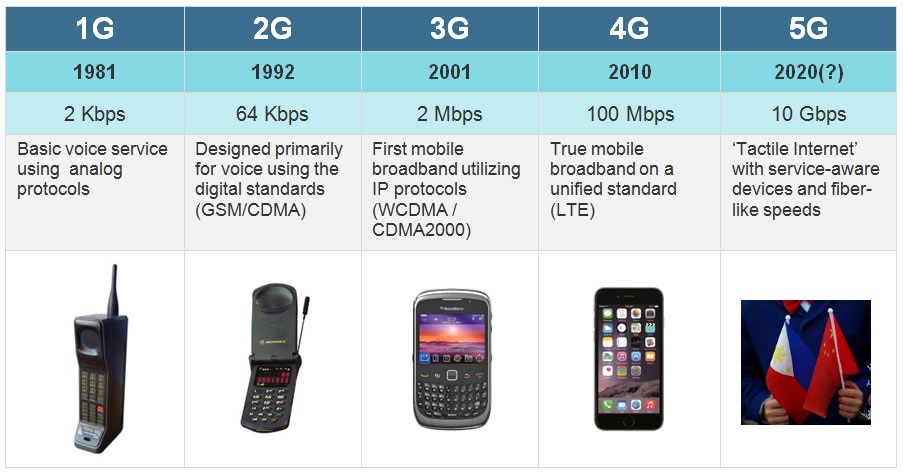
China - Philippines Bridging for the 5G Wireless Internet Preparation 2020

Null
Philippine Telco's are in the preparation for 5G wireless mobile internet for 2020

What is 5G Mobile Internet?


5th generation mobile networks or 5th generation wireless systems, abbreviated 5G, are the proposed next telecommunications standards beyond the current 4G/IMT-Advanced standards.

Rather than faster peak Internet connection speeds, 5G planning aims at higher capacity than current 4G, allowing higher number of mobile broadband users per area unit, and allowing consumption of higher or unlimited data quantities in gigabyte per month and user.

This would make it feasible for a large portion of the population to stream high-definition media many hours per day with their mobile devices, when out of reach of Wi-Fi hotspots.
5G research and development also aims at improved support of Device-to-device communication, aiming at lower cost, lower latency than 4G equipment and lower battery consumption, for better implementation of the Internet of things.
There is currently no standard for 5G deployments.

The Next Generation Mobile Networks Alliance defines the following requirements that a 5G standard should fulfill:
  1. Data rates of tens of megabits per second for tens of thousands of users
  2. Data rates of 100 megabits per second for metropolitan areas
  3. 1 Gb per second simultaneously to many workers on the same office floor
  4. Several hundreds of thousands of simultaneous connections for massive wireless sensor network
  5. Spectral efficiency significantly enhanced compared to 4G
  6. Coverage improved
  7. Signaling efficiency enhanced
  8. 1-10 ms latency (limited by speed of light)
  9. Latency reduced significantly compared to LTE

The Next Generation Mobile Networks Alliance feels that 5G should be rolled out by 2020 to meet business and consumer demands. In addition to providing simply faster speeds, they predict that 5G networks also will need to meet new use cases, such as the Internet of Things (internet connected devices) as well as broadcast-like services and lifeline communication in times of natural disaster.

Carriers, chipmakers, OEMS and OSATs, such as Advanced Semiconductor Engineering (ASE), have been preparing for this next-generation (5G) wireless standard, as mobile systems and base stations will require new and faster application processors, basebands and RF devices.

Null

China’s Huawei, Philippine Telco join forces in 5G deal


Chinese electronics giant Huawei is joining forces with the Philippines' largest telco in the hopes of rolling out a 5G wireless network in the Asian archipelago by 2020, the Filipino company said.

Filipinos are among the world's most active Internet users, but the country also has one of the slowest average connection speeds.

Smartphone usage is also steadily growing with about 33 million people owning devices according to researchers.

Philippine Long Distance and Telephone Co (PLDT) and Huawei agreed last month to conduct joint research and development into fifth-generation broadband wireless technology for the Philippines.

"They are one of the companies that are leading in the research and development of 5G technology," PLDT spokesman Ramon Isberto said about the Chinese firm, adding it is already involved in PLDT's landline and mobile phone services.

Chinese telecoms behemoth Huawei is the world's number three smartphone maker, operating in 170 countries.

The company has laid out an ambitious agenda for the US and global markets – hoping to become the top producer of smartphones in the next five years despite controversy over its ties to Beijing.


Ren Zhengfei, a former People's Liberation Army (PLA) engineer, founded the company in 1987 but his PLA service has led to concerns of close links with the Chinese military and government, which Huawei has consistently denied.

The US and Australia have previously barred Huawei from involvement in broadband projects over espionage fears.

Relations between Manila and Beijing have been rocky amid conflicting claims over the South China Sea and China's militarisation of the resource-rich waterway.

But under Philippine President Rodrigo Duterte, who won May elections in a landslide, there has been a warming of bilateral ties as Duterte steers Manila away from the US – its long-time defence treaty partner.

Isberto said controversy over Huawei's links with the Chinese government was not a concern, stressing that foreign companies only provide technology.

"At the end of the day, we run our networks," he said. — AFP

The Philippines and KR big winners from China's slowdown but Fearing Investors for MARCOS Jr bid for 2016 Presidency

Null

The Philippines and South Korea are the big winners from China's slowdown

How panicked were investors last week about China's stock market plunge? Enough to treat the Korean peninsula, a place that was teetering on the brink of war, as a safe haven.

Even as policy makers braced for renewed military confrontation between North and South Korea, the won staged a rally.

It may be time to start counting Korea as a developed nation, rather than an emerging market. 

That's made South Korean assets one of the few bright spots in a dark time for emerging markets. On August 24 alone, investors yanked $2.7 trillion out of developing nations, with Indonesia, Malaysia and Thailand especially hard hit. It matched the violent September 2008 selloff after Lehman Brothers collapsed.

Back then, Korea was battered so hard that pundits were calling it the "next Iceland" and the "Bear Stearns economy". Now, together with the Philippines, it's one of Asia's only refuges from chaos.

It's not hard to explain why many Asian economies are suffering from China's slowdown. Exporters of commodities, who depended on a humming Chinese market, have especially suffered. But why are there such big outliers among battered emerging markets?

Less like lemmings

The answer is that investors are finally basing their decisions less on herd mentality than nuanced, case-by-case analyses.

"Emerging market investors have become a lot savvier," says economist Frederic Neumann of HSBC in Hong Kong.

"Gone are the days where emerging markets were all lumped into one bucket. Today, countries with stronger fundamentals are able to resist the spread of contagion washing over global financial markets."

Along with South Korea and the Philippines, Neumann notes that even some frontier economies, like Vietnam, "have weathered global financial turmoil with apparent ease".

The common link among the success stories is they've got the basics right since Asia's 1997 financial meltdown. They have healthier financial systems, greater transparency, stronger banks, sober national balance sheets, and reasonable current-account deficits.

Malaysia's reckoning, by contrast, is long overdue.

The ringgit is trading near 17-year lows because scandal-plagued Prime Minister Najib Razak cares more about staying in power than modernising the country's unproductive economy.

Meanwhile, Thailand's military junta is undoing much of the progress Bangkok made since the late 1990s in strengthening the rule of law. And for all its gripes that Indonesia is being unfairly lumped in with Asia's laggards, President Joko Widodo's administration is rapidly losing the trust of investors.

While there's still time to win it back, Widodo's first 315 days in office have been a case study in timidity, drift and lost opportunities.

Korea credible

Korea, by contrast, is on the "more credible side of the spectrum," says economist Marc Chandler of Brown Brothers Harriman.

Even though China's downshift and US interest rate hikes will eventually make a dent, the won was Asia's top performer last week. Its 2.7 percent gain almost matched the drop in the Chinese yuan since August 11.

Meanwhile, Korean bond yields are falling. It turns out that the world's central banks had it right last year when they boosted their Korean debt holdings. In 2014, they made up 45.4 percent of the foreign-held portion of Korea Treasury bonds, up from 41.8 percent a year earlier.

It may be time to start counting Korea as a developed nation, rather than an emerging market. Korea still faces many challenges, not least of which are its rogue family-run conglomerates. But its macroeconomic performance deserves the recognition it's receiving from investors.

The same goes for the Philippines. Since 2010, President Benigno Aquino has steadily improved his nation's debt position (winning investment-grade ratings in the process), attacked graft and drawn in waves of foreign-direct investment.

Last month, reporters asked Philippine central bank governor Amando Tetangco if he's worried about the spectre of economic crisis haunting Asia at the moment.

"There's a herd mentality," he said, "but there'll be differentiation."

So far, he's been proven right. The country formerly derided as the "sick man of Asia" has been standing its ground amid market chaos.

Still risks

Risks abound, of course. While South Korea's economic fundamentals are stable – it's growing at a rate of 2.2 percent with a 3.7 percent jobless rate – its high household debt of $458 billion is a concern.

Manila, for its part, faces an uncertain 2016 election, in which Ferdinand Marcos Jr, son of the dictator who ravaged the nation in the 1970s and 1980s, may make a bid for the presidency. History has shown that emerging markets are often just one bad leader away from relapsing into chaos.

For now, the relative stability washing over Korea and the Philippines underscores that steady leadership and long-term thinking matter. It also shows that global investors are getting better at identifying those factors in Asia. - Bloomberg / The Sydney Morning Herald

The Fate of West Philippine Sea/South China Sea at the United Nation's Tribunal begin its Journey in Hague vs China

Null

The Philippine delegation, with lawyers and advocates, before the start of Commencement of the 1st Round of Philippines Argument.- Image CNN Philippines

South China Sea dispute: Philippines warns China flouting UN maritime laws

THE HAGUE: The Philippines has appealed to an international tribunal to declare China's claims to most of the South China Sea illegal, warning the integrity of United Nations' maritime laws is at stake.

In opening comments to the tribunal in the Hague on Tuesday, Foreign Secretary Albert del Rosario said the Philippines had sought judicial intervention because China's behavior had become increasingly "aggressive" and negotiations had proved futile.

Del Rosario said the UN's Convention on the Law of the Sea, which the Philippines and China have both ratified, should be used to resolve their bitter territorial dispute.

"The case before you is of the utmost importance to the Philippines, to the region, and to the world," del Rosario told the tribunal.

"In our view, it is also of utmost significance to the integrity of the convention, and to the very fabric of the legal order of the seas and oceans."

China insists it has sovereign rights to nearly all of the South China Sea, a strategically vital waterway with shipping lanes through which about a third of all the world's traded oil passes.

Its claim, based on ancient Chinese maps, reaches close to the coasts of its southern neighbors.

The Philippines, Vietnam, Malaysia, Brunei and Taiwan also have claims to parts of the sea, which have for decades made it a potential military flashpoint.

Tensions have risen sharply in recent years as a rising China has sought to stake its claims more assertively.

Following a stand-off between Chinese ships and the weak Filipino Navy in 2012, China took control of a rich fishing ground called Scarborough Shoal that is within the Philippines' exclusive economic zone.

China has also undertaken giant reclamation activities that have raised fears it will use artificial islands to build new military outposts close to the Philippines  and other claimants.

China has rejected all criticism over its actions, insisting it has undisputed sovereign rights to the sea.

However del Rosario told the tribunal in the Hague that China's argument of claiming the sea based on "historic rights" was without foundation.

"The so-called nine dash line (based on an old map used by China) has no basis whatsoever under international law," he said.

The Philippines submitted its case to the Hague-based Permanent Court of Arbitration, a 117-state body that rules on disputes between countries, in early 2013.

Del Rosario's comments, held in closed door proceedings but released by his office in Manila on Wednesday, were part of the Philippines' opening oral arguments.

China has refused to participate in the proceedings and said it will not abide by any ruling, even though it is has ratified the UN's Convention on the Law of the Sea.

However the Philippines hopes a ruling in its favor will pressure China into making concessions.

Any ruling from the tribunal is not expected until next year.

Null

The week covering July 7 to 13 will be pivotal to the Philippines’ legal battle to assert its claims over the portion of the South China Sea that it calls the West Philippine Sea.- Image CNN Philippines

Day 1: PH begins arguments in The Hague

On July 7, 2015, the Philippines has begun arguing before the Permanent Court of Arbitration in The Hague that the treaty-based court has jurisdiction — and should intervene — in the country's dispute with China over the West Philippine Sea.

Malacañan said the first day of hearings began with Solicitor General Florin Hilbay's introduction of the Philippines' case, and his presentation of the order of speakers.

Foreign Affairs Secretary Albert del Rosario made a plea for the tribunal to recognize its jurisdiction. He noted that the case is important not just to the country but also to the global community, owing to its impact on the rule of law in maritime disputes.

Paul Reichler, chief counsel of the Philippines, presented the justification for the five-man tribunal's jurisdiction over the Philippine claims under the United Nations Convention on the Law of the Sea (UNCLOS).

Reichler was followed by Philippe Sands, who explained that the Philippines did not raise questions of sovereignty over land or maritime delimitation.

Sands is the director of the University College London's Centre on International Courts and Tribunals.

The first round of Philippine arguments will continue Monday  (July 8) with two more hearings, from 4 p.m. to 7 p.m. and 8:30 p.m. to 11:30 p.m., Philippine time.

A few hours before the hearing, Undersecretary Abigail Valte, deputy presidential spokesperson, told CNN Philippines that the delegation is cautiously optimistic that the tribunal would rule in favor of Philippine' on the jurisdiction issue.

Valte is also in The Hague with the Philippine delegation.

"We have been preparing every day, every step of the way to come to a proceeding like this," she said.

China has refused to take part in the proceedings. It prefers to conduct bilateral talks with the Philippines. Sources: CNN Philippines and The Economic Times

China stock loses $3.2 trillion US Dollars in weeks; Suicide rumor -Economy facing trouble

Null

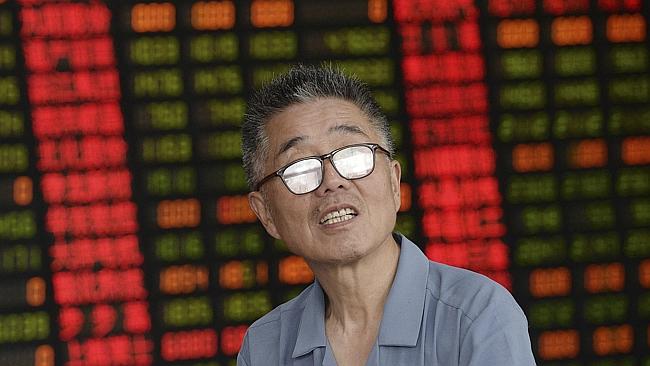
A stock investor looks up in a brokerage house in Shanghai. Chinese authorities have launched frantic efforts to shore up plunging stock prices following another 5.7 per cent decline in the country's main market index on Friday. Source: AP

Chinese chaos worse than Greece: Chinese stock market loses $3.2 trillion, authorities inject cash

WHILE the world worries about Greece, there’s an even bigger problem closer to home: China.

A stock market crash there has seen $3.2 trillion wiped from the value of Chinese shares in just three weeks, triggering an emergency response from the government and warnings of “monstrous” public disorder.

And the effects for Australia could be serious, affecting our key commodity exports and sparking the beginning of a period of recession-like conditions.

“State-owned newspapers have used their strongest language yet, telling people ‘not to lose their minds’ and ‘not to bury themselves in horror and anxiety’. [Our] positive measures will take time to produce results,” writes IG Markets.

“If China does not find support today, the disorder could be monstrous.”

In an extraordinary move, the People’s Bank of China has begun lending money to investors to buy shares in the flailing market. The Wall Street Journal reports this “liquidity assistance” will be provided to the regulator-owned China Securities Finance Corp, which will lend the money to brokerages, which will in turn lend to investors.

The dramatic intervention marks the first time funds from the central bank have been directed anywhere other than the banks, signaling serious concern from authorities about the crisis.

At the same time, Chinese authorities are putting a halt to any new stock listings. The market regulator announced on Friday it would limit initial public offerings — which disrupt the rest of the market — in an attempt to curb plunging share prices.

While the exact amount of assistance hasn’t been revealed, the WSJ reports no upper limit has been set.

All short-selling — the practice of betting that stocks will fall — has been banned, and Chinese media has rushed to reassure citizens.

Yesterday, shares in big state companies soared in response to the but many others sank as jittery small investors tried to cut their losses, Associated Press reports. The market benchmark Shanghai Composite closed up 2.4 percent but still was down 27 percent from its June 12 peak.

Experts fear it could turn into a full-blown crash introducing even more uncertainty into global markets as Europe teeters on the edge of a potential euro zone exit by Greece, after Sunday’s controversial referendum.

WHAT DOES IT MEAN FOR AUSTRALIA?

For Australia, the market crash in China is likely to impact earnings on key exports iron ore and coal, further slashing government revenue, while also putting downward pressure on the Australian dollar.

Jordan Eliseo, chief economist with ABC Bullion, said it was important to remember that the amount of wealth Chinese citizens have tied up in the stock market is relatively minor compared with western investors.

Stocks only make up about 8 per cent of household wealth in China, compared with around 20 per cent in developed nations.

“The market crash there is generating headlines, but it’s not going to have the same impact as a comparable crash would in a developed market,” he said.

“What it means for Australia, though, is it’s very clear there are some serious imbalances in the Chinese economy, and the rate of growth they’ve enjoyed in the past is over. There’s no question our export earnings are going to take another hit.”

Mr Eliseo predicts Australia is likely to experience “recession-like” conditions such as negative wage growth for many years to come. “I believe that’s going to be the new norm,” he said.

CRACKDOWN AS PANIC TRIGGERS ‘SUICIDE’ RUMOURS

Underscoring growing jitters amid the three-week sell-off, police in Beijing detained a man on Sunday for allegedly spreading a rumor online that a person jumped to their death in the city’s financial district due to China’s precarious stock markets.

The 29-year-old man detained was identified by the surname Tian, and is a manager at a technology and science company in Beijing, police said in a post on their official microblog.

Police said Tian’s alleged posting of the rumor took place Friday and called on internet users to obey laws and regulations, not to believe and spread rumors, and to cooperate with police.

The state-run Xinhua news agency reported that Tian allegedly posted the rumors with video clips and screenshots Friday afternoon.

The post, which is said to have gone viral, “provoked emotional responses among stock investors who suffered losses over the past weeks”, Xinhua said.

Xinhua added that a police investigation showed that the video in question had been shot on Friday morning in the eastern Chinese province of Jiangsu where a man had jumped to his death. Local police there were investigating that case, Xinhua said.

The original post was unavailable Sunday on China’s tightly controlled social media, where authorities are quick to delete controversial material. - Jews News /  News.com.au

Ramos Killed NSC Asia's Biggest Steel Factory in ILigan City to allow China Dominates the Philippines

Null
Former Philippine President Fidel V. Ramos Sold the National Steel Corporation (NSC) in Iligan City to Malaysia as part of his Privatization program. NSC was Asia's largest Steel factory.

Bulacan to host Chinese - Philippines’ biggest steel plant

Steel Asia, the country’s largest steel manufacturer, is investing P6 billion to put up the biggest steel plant in the country.

Steel Asia said the plant in Plaridel would be among the most modern in the world.

“It will be using the latest available technology that allows production efficiency and environmental protection at the same time,” the company said.

The Plaridel plant will have a production capacity of 1.2 million metric tons, more than double the capacity of its recently inaugurated P3 billion Davao plant which is at 500,000 metric tons.

The Davao plant generated around 2,000 direct and indirect jobs while the Plaridel plant is expected to create nearly 3,000 direct and indirect jobs, Steel Asia said.

Roberto Cola, Steel Asia vice president, said the Plaridel plant would feature an array of environmental measures that will allow the company to fully comply with existing laws.

Despite various groups who are against the project, Steel Asia said majority of the residents of Plaridel are now supporting the rolling mill project in the area.

Steel Asia said an independent survey conducted by Greenboroughs Tech Inc. showed 82 percent of the sampling from the direct impact area support the project.

The company said it has been conducting continuing efforts to explain the technical and environmental aspects of the plant, and its benefits to the community and its environment.

In an official public consultation conducted last month, Steel Asia said the project has obtained the support from more than 5,000 federation of tricycle associations of Plaridel.

The project was also supported by the youth many of whom have already taken advantage of the free skills upgrade training program Steel Asia has been conducting for the community, the steel manufacturer said.

“Being open and transparent with the community was key to the support we are getting for our project. We even brought some members of the Plaridel community to our newly opened Davao plant for them to see and appreciate that we are real partners in progress and we care for the environment as we go about our business,” Cola said.

Steel Asia has existing plants in Cagayan de Oro, Davao, Cebu, Batangas, and two in Bulacan.

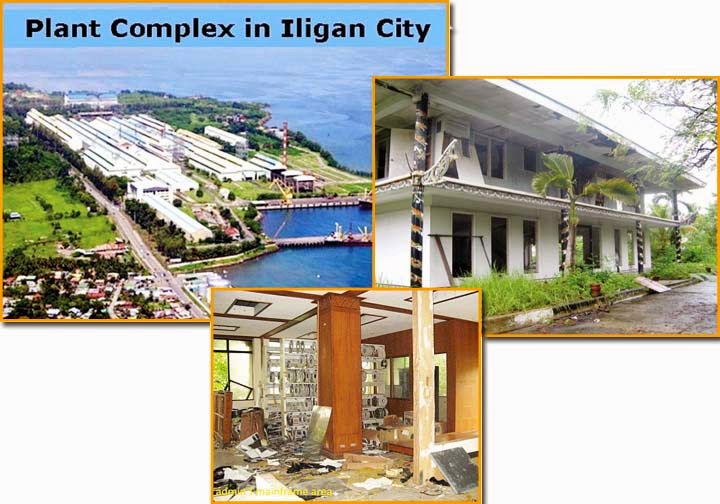
NSC Iligan plant rots

Null
National Steel Corporation, Asia's Biggest Steel Manufacturing Facility is rotting .... image source: Manila Bulletin

While the government is moving heaven and earth to revive the country’s manufacturing sector, which is the biggest hope to provide employment to the less educated Filipinos who cannot be accepted in call centers and BPO works, it has lost sight of the country’s biggest industrial plant — the National Steel Corp. (NSC), which used to be the symbol of the country’s march towards industrialization.

NSC has been abandoned, looted and is now rotting in its 145-hectare industrial complex in Iligan City.

Cong. Vicente F. Belmonte Jr. of the lone legislative district of Iligan City in a phone interview with Business Bulletin blamed the national government policy for making  NSC, which used to employ as many as 4,200 Filipinos, into what it is today — a big white elephant.

“The national government they don’t give importance to the NSC. We are at the mercy of the national government because they make the policy,” Belmonte said.

Belmonte noted of the privatization thrust that put NSC to owners that did not really take seriously the business of NSC.

Under the government’s privatization policy, the NSC facilities were  turned over to the Malaysian investors in 1995.  The Indian investors subsequently took over in 2004 and the mills eventually went on total shutdown in 2009.

“We made a mistake in awarding the NSC to the Indians,” Belmonte pointed out. NSC was acquired by Pramod Mittal’s Global Steel Holdings Ltd. from creditor banks in 2004 for a total price of P13.25 billion including an upfront cash of P1 billion while the remainder was to be paid over an 8-year period. That privatization was overseen by then DTI Secretary Mar  Roxas.

At that time of privatization, NSC’s debts were placed at P16.18 billion but its assets had been assessed at P29.27 billion. The Philippine National Bank (PNB) has the largest exposure to the company of R5.64-billion. Government-owned Land Bank of the Philippines followed with P1.2 billion.

Belmonte said the Indian owners were not interested in running a sustainable plant but they only produced specific steel products to supply its mother company. Its intention was to use the NSC property as a collateral for its loan and when it failed to do so, it filed a case before Singaporean arbitration court and won.

A source said, the Philippines or the creditor banks’ defense team was said to be poorly represented in that Singapore case making it an easy win for Global Steel.

Now, Global Steel and creditors/banks are caught in an arbitration gridlock situation in Singapore.

“We have many plans for NSC, but we need the national government’s support,” he said.

According to Belmonte, he already approached Finance Secretary Cesar Purisima but the Finance chief was non-committal. He has also asked the Department of Trade and Industry, but was told the agency cannot do anything because NSC had long been privatized.

Belmonte also confirmed the looting incidents inside the huge complex. He said that when NSC was privatized it had a R1 billion worth of parts inventory. Some of these have been looted or sold.

Just last week, he said, some 61 trees inside the complex were balled off on the pretext that those grown up trees were on harms way of electric cables, but were actually sold for cash.

“There are guards, but not enough to secure the entire premises,” he said. NSC, the first government corporation to obtain an ISO-certification, is complete with staff houses and other real estate assets inside its sprawling premises.

It was also the first government corporation to be declared Employer of the Year. And also the first government corporation to be bestowed AIM’s Award for Managerial Excellence in people development.

POLICY INTERVENTION

“We need government policy intervention for the steel industry,” Belmonte said. Policy interventions that should correct some factors that led to NSC’s fate.

For instance, when NSC was sold to Global Steel, it had the advantage of a lower power cost at R3 only because Mindanao was then relying mostly on hydro power. But when the government policy  was changed on the power mix for Mindanao, NSC was caught up with a high power of R6 to R8 per kilowatt-hour.

The Indian owners closed the plant in 2009 after workers staged a strike for non-payment of wages.

Along with its closure, the Global Steel also incurred over R3 billion in unpaid electricity bills before the National Power Corp. It also failed to pay real estate taxes amounting to over R2 billion to the city government of Iligan.

Since the tide of trade liberalization can no longer be reversed, Belmonte said there are some new technologies that could possibly put NSC back on its feet. He said NSC can operate using its own generated power.

“The national government should come in now and adopt a policy for the steel industry, because even if we in Iligan are very much interested in reviving NSC, we are very limited,” he stressed.

Thus, he said, there is a need for government policy to attract new investors and revive NSC.

“The government need not take over the plant, we just need a government policy that should make the domestic steel manufacturing industry attractive to investors again,” he stressed.

While Belmonte admitted that the NSC as it is today can no longer be competitive, he said there are new technologies that could help NSC back on its feet and become competitive again.

“We can revive it, but it is no longer competitive.  We need new policy because we can no longer survive under the old strategy. We have to adapt new technology for the steel industry,” he said.

For instance, he cited a Vienna technology where a steel plant can operate using its own power.

DISCONNECT

When the NSC was privatized in 1995, it was on the premise that the new investors must further expand/upgrade and eventually integrate upstream into the iron and steel-making stage.

Due to this failed privatization, the flat steel subsector has a serious supply-chain gap today arising from the idle Hot Mill, Cold Mill and Tinplate Line; while the long products subsector has a diminished supply capacity from the shutdown Billet Shop.

During its peak, NSC supplied 62 percent of the Philippine total flat steel demand (34 percent for hot-rolled products; 75 percent for cold-rolled products; 69 percent for tinplate products). It used to directly export an average of 4,000 MT per month to China

NSC generated R12 billion in annual revenues and earned a net income of P500 million every year, after paying duties and taxes of R1 billion yearly to the government.

Upon expansion/upgrading in 1985-1995, this government steel plant had total assets of R30 billion when it was privatized in 1995.

In one of the DTI workshops for the crafting of the industry roadmaps, including the steel industry, state-run National Development Co. (NDC), which has a minority five percent stake in NSC, was urged by the private sector to take over NSC.

NSC was one of the 11 industrial projects created by NDC, the government investment arm under the DTI, during the Marcos era.

Despite all the legal encumbrances that NSC finds itself entangled into, it is so ironic that while the government seeks to revive the manufacturing sector, what used to be the crown jewel of the government’s attempt at industrialization continues to rot, looted and ransacked.

Sources: PHILSTAR and MANILA BULLETIN
Investment Recommendation: Bitcoin Investments

Live trading with Bitcoin through ETORO Trading platform would allow you to grow your $100 to $1,000 Dollars or more in just a day. Just learn how to trade and enjoy the windfall of profits. Take note, Bitcoin is more expensive than Gold now.


Where to buy Bitcoins?

For Philippine customers: You could buy Bitcoin Online at Coins.ph
For outside the Philippines customers  may buy Bitcoins online at Coinbase.com