Filipinos in South Korea
Showing posts with label Politics. Show all posts

RA 10951 Anti Fake News Law in the Philippines - Penalty up to ₱20 Million, 20 years imprisonment

Republic Act (RA) 10951 Anti Fake News Law in the Philippines - Penalty up to ₱20 Million, 20 years imprisonment

2 Months Old Senate Bill

On 22nd June, 2017, Senator Joel Villanueva filed  for anti-fake news bill that gives stiffer penalties to erring public officials, After 2 months from the date of filing, the said bill was approved by President Duterte in Law of the Republic, a law amending amounts and fines imposed under the 87-year-old Revised Penal Code.

In filing Senate Bill No. 1492 or An Act Penalizing the Malicious Distribution of False News and Other Related Violations, Villanueva said false news or information are those which either intend to cause panic, division, chaos, violence, and hate, or those which exhibit a propaganda to blacken or discredit one’s reputation as reported by the Manila Bulletin on the 22nd June 2017 and published in the Senate Press released on the same date

Approved into law

As published in CNN Philippines, on 29th August 2017, the said bill was approved into law by President Duterte as Republic Act (RA) 10951, a law amending amounts and fines imposed under the 87-year-old Revised Penal Code.

Among the key amendments is a penalty of imprisonment for up to six months and a fine of up to ₱200,000 (US$3,910) for spreading false news.

Under Section 18, Article 154, titled "Unlawful use of means of publication and unlawful utterances" penalties will be imposed on a person who will publish false news by passing it off as legitimate news through print or other publication methods.

"Any person who by means of printing, lithography, or any other means of publication shall publish or cause to be published as news any false news which may endanger the public order, or cause damage to the interest or credit of the State," it reads.

The penalties of "arresto mayor" or imprisonment of one month and a day to six months, and a fine ranging from ₱40,000 to ₱200,000 await those found guilty of publishing fake news.

Under the same article, the penalties will also apply to those who deliver speeches that encourage disobedience to the law, publish an official document without proper authority, and those who will publish pamphlets anonymously.

Sky-high fines for sedition

Under R.A. 10951, the leader of a sedition will now have to pay a  fine of up to ₱2 million, from the previous ₱10,000 under the Revised Penal Code. The leader will be imprisoned from six years and a day, to eight years under Section 7, Article 140.

Those who will conspire to commit the crime of sedition will be  punished by "prison correccional" or two years, four months and a day; to four years and two months; and fined not exceeding ₱1 million. The fine is up from ₱5,000.

Those who will incite others to sedition by means of speeches, proclamations, banners, and other representations will be fined up to ₱400,000 and imprisoned from four years and two months and a day to 12 years. The fine is raised from ₱2,000.

Any mass media enterprise or social media platform that fails, neglects, or refuses to remove false news would be penalized with a fine ranging from ₱10 million to ₱20 million and imprisonment ranging from 10 to 20 years.

It also penalizes any person who by means of printing, or by words, utterances or speeches shall encourage disobedience to the law or to the constituted authorities or praise, justify and extol any act punished by law.

Libel, slander

Libel by means of writings or similar means was amended under Section 91, Article 355.

It now imposes imprisonment or a fine ranging from ₱40,000 to ₱1.2 million, from the previous ₱200 to ₱6,000.

Slander or oral defamation will now be fined not exceeding ₱20,000 from ₱200.

In a news release, the Malacanang presidential palace said the 50-page law with 102 sections consists of provisions adjusting the amount of fines, as well as the amount or the value of property and damage on which a penalty is set.

The law adjusted the fines on certain crimes against national security, such as treason and crimes against public order, such as rebellion and sedition.

The Philippine military has been fighting pro-ISIS militants in Marawi City since May, 23 this year. There has been widely-spread false news and propaganda from rebel groups on social media. The Philippine government urged media and citizens to listen to authorities and stop spreading fake news on several occasions.

With sources from CNN Philippines, Manila Bulletin, Senate press release, Malacanang Palace News Release

Copy of the said law is still needs to be obtained and be published in this website to further validate the penalties mentioned above.

Racist Canadian Woman Viral for Harassing Elderly Filipino Couple in Canada


Racist Canadian woman in action, other Canadian passengers defended the Filipino couple
Racist Canadian woman in action, other Canadian passengers defended the Filipino couple. Photo: nextshark.com

Metro Vancouver Transit Police is now investigating the case of a viral video showing a racist 75-year-old Westminster woman verbally abusing an elderly couple from the Philippines on the SkyTrain.

The incident happened on the Millennium Line on Aug. 21 between the stations Sperling/Burnaby Lake and Brentwood Town Centre in Vancouver, Canada, The Georgia Straight reported. The authorities have now launched an investigation after a review of the video “determined that the aggressor in this situation had used profane and racially slanted language toward the elderly couple.”

The racial tirade of the woman began after hearing the elderly Filipino couple speaking Tagalog.

According to Paula Correa, the witness who managed to catch some of the incident on video, the racist woman interrupted the elderly couple’s conversation after hearing them speak in Tagalog and told them to be quiet, Global News reported.

The tirade eventually led the unnamed woman to telling the Filipino couple to, “go back to the f—ing Philippines,” and further telling them, “If you decide to live in this country, you should learn how to speak English.”

Video: Racist Canadian woman in action, other Canadian passengers defended the Filipino couple. Photo: facebook.com

Interestingly enough, most Filipinos are actually bilingual. English is one of the two commonly used and official language in the Philippines alongside the country’s national dialect, Tagalog.

“We speak both English and Tagalog or whatever dialect we speak. It’s ridiculous how ignorant people are. The couple was replying to [her] perfectly well in English,” Correa said.

Many people joined in to defend the elderly couple. One man tried to defend them but the racist woman switched her aggression towards him and assaulted him verbally as well.

The woman cursed at the couple right before leaving the train, Correa said. And some people even heard her yelling after the door closed.

The unnamed woman, according to the news released by the authorities, is known to the police for having anger-related issues.  Read more at NextShark

Cheap flight tickets to canada

Duterte signed “Free Tuition Fee law” for all State Universities and Colleges- ₱100 billion Budget

“Free Tuition Fee law”  in the Philippines
[Free Tertiary Education] Free Tuition fee law in the Philippines

Universal Access to Quality Tertiary Education Law for bottom 20% poor but deserving Filipino students

- Free tuition fee for all state colleges and universities
- Free Library access
- Free  ID
- Free laboratory access

President Duterte has signed into law the Universal Access to Quality Tertiary Education Act which grants free tuition to all state universities and colleges (SUCs) in the country.

This despite the suggestion of a veto by Budget Secretary Ben Diokno as the government cannot afford to shoulder its cost estimated to be around ₱100 billion.

During the Mindanao Hour press briefing Friday morning, Senior Deputy Executive Secretary Menardo Guevarra said that the President signed the bill Thursday night.

“The enrolled bill came to the Office of the President nearly 30 days ago and during that period, there had been a lot of discussions and study about the bill because of its heavy budgetary implication” he explained.

Guevarra said that free tertiary education in SUCs is a very strong pillar or cornerstone of Duterte’s social development policy and that the President was still trying to figure out the best possible solution regarding the bill.

“So we weighed everything and came to the conclusion that the long-term benefits that will be derived from a well-developed tertiary education on the part of the citizenry will definitely outweigh any short-term budgetary challenges,” he said.

The Palace official also said that whether or not economic managers are for the passing of the bill, the more important thing now is to find the budgetary allocation for the program.

“Everyone, including the economic managers, will have to focus their attention on funding for this program because this will have to be implemented soon,” Guevarra said, adding that the SUC law will be implemented on the next school year.

Since the government has already submitted the proposed 2018 national budget to Congress, Guevarra said that certain adjustments can still be made so allocation for the law can be made.

“That is really the principal responsibility of Congress when they deliberate on the budget. Right now, I have nothing very specific to say about which projects or which programs or which agency’s proposed budget might be affected,” he said.

“If Congress is really serious in finding the appropriate funding for this free tuition program, they will have to find the necessary sources for this particular program,” he added.

Guevarra also addressed the estimate of the Department of Budget and Management (DBM) that ₱ 100 billion would be needed to implement the SUC law.

“The Commission on Higher Education (CHED) thinks otherwise. The ₱ 100-billion estimate of the DBM seems to be on the very high side because that is on the basis on the assumption that all aspects of the free tuition bill will be implemented all at the same time,” he said.

The CHED estimated that ₱ 34.1 billion would be needed for the implementation of the law.

According to Guevarra, the government would only have to spend on the mandatory provisions of the bill which includes tuition and miscellaneous fees which would need around ₱ 16 billion.

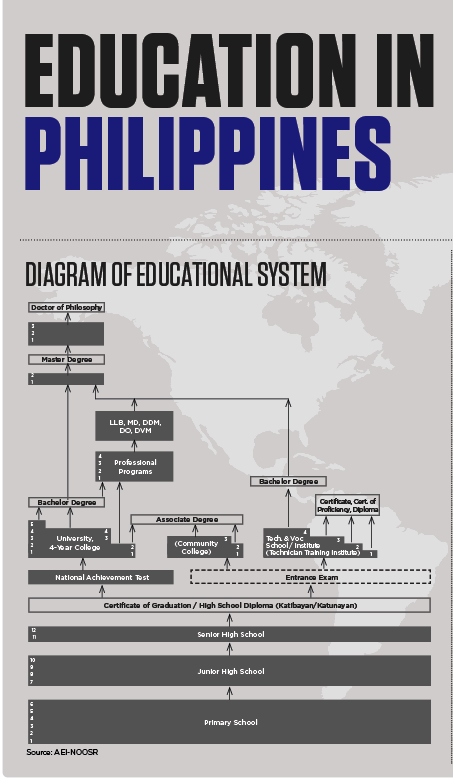
Education System in the Philippines
Diagram of educational system in the Philippines - wes.org

The related educational expenses like books and boarding would be shouldered for “deserving 20 percent” by the CHED’s Unified Student Financial Assistance System for Tertiary Education (UniFAST) program.

“As far as I know those are the only mandatory provisions of the bill for now – the free tuition and other fees. Other fees would refer to something like library fees, ID fees, laboratory fees, and stuff like that,” Guevarra explained.

“Now as to the subsidy for related educational expenses, that is something to be processed by the UniFAST board which is supposed to have a system of priority,” he said, adding that the fund and system under the UniFAST are yet to be established.

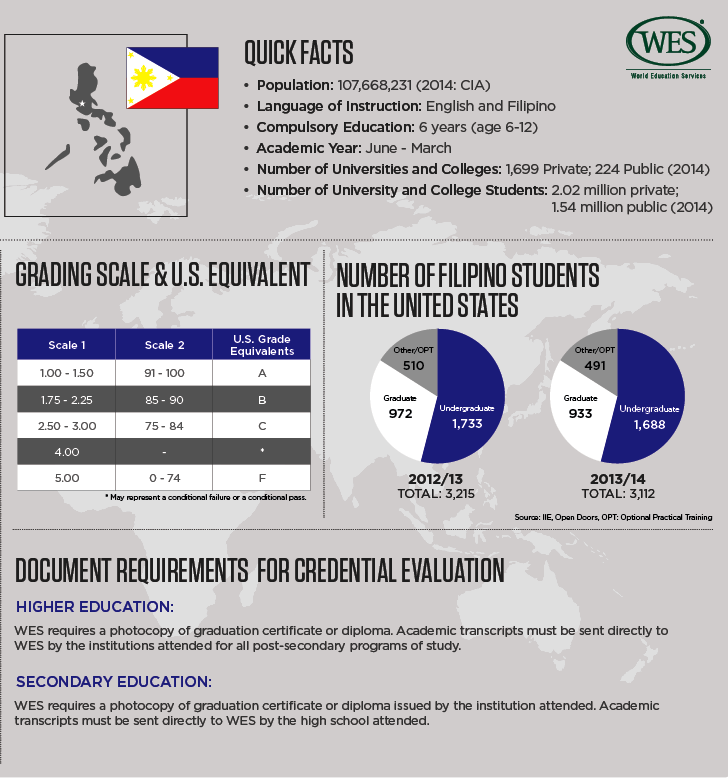
Null
Grade scaling for the educational system in the Philippines vs USA Education System - wes.org

“In other words, ‘yung mga talagang nangangailangan, the bottom 20 percent, will be prioritized in terms of subsidy for educational-related expenses,” he added.

The UniFAST rationalizes the allocation, utilization and client-targeting of government resources and improves access to quality higher and technical education for those who need it.

It also serves as the ultimate national human resource development mechanism and strategy that will direct beneficiaries to priority courses needed for economic growth and development. - By Argyll Cyrus Geducos from Manila Bulletin

Philippine Marines Seized ₱79 Million ISIS Terrorism Funding in Cash and Checks in Marawi City

Null
After the inventory, the money and checks were turned over to the Joint Task Force Marawi for safekeeping.Photo: CNN Philippines

 ₱27 million-worth of checks bears the issuing bank and the bank account owner could answer who funded the terrorism.

Terrorism Funding in the Philippines

The Philippine Marines recovered ₱52 million in cash in a house in Marawi City.

During a clearing operation near Mapandi Bridge on Monday afternoon, the Marines discovered the money and ₱27 million-worth of checks.

The Marines reported the house was an abandoned machine gun position of the armed terror group Maute.

After the inventory, the money and checks were turned over to the Joint Task Force Marawi for safekeeping.

The Maute group has been battling government troops since May 23 in Marawi City, reportedly to protect the "emir" or leader of ISIS in the Philippines, Isnilon Hapilon, who is believed to be in the area.

Hapilon is allegedly working with the Maute group to establish a "wilayat," or caliphate of ISIS in Lanao del Sur.

The ongoing violence in Marawi forced President Rodrigo Duterte to declare martial law and suspend the privilege of the writ of habeas corpus over the entire Mindanao region on May 23.

Checks a Key - Who funded Terrorism in in the Philippines?

The recovered ₱52 million in cash in a house in Marawi City where the abandoned machine gun position of the armed terror group Maute found could not tell who give the cash and who funded the terrorism in the Philippines but the ₱27 million-worth of checks bears the issuing bank and the bank account owner could answer who funded the terrorism.

Philippine Banking system is strictly following the high standard requirements through the mandate of the Banko Sentral ng Pilipinas and the Law that protect every account holder  for their privacy and safety.

With the existing Martial law in the entire island of Mindanao, in which the Military has full jurisdiction in the place where the checks was discovered, the issuing bank and the account holder at this point would be disclosed easily with lesser interference from any government agency to protect the privacy of the account holder.

Who is the account holder and who funded the terrorism in the Philippines?

With report from CNN Philippines.

Global Research Pointed: USA, Loida Lewis and Liberal party behind the ISIS attack in the Philippines

 Global Research Pointed: USA, Loida Lewis and Liberal party behind the ISIS attack in the Philippines
GlobalReaseach.ca pointed out who are behind the Islamist terrorist attack in Marawi City in Southern Philippines

In the article written by Stephen Lendman lives in Chicago, USA, he pointed that Washington, Loida Lewis and the Liberal Opposition party in the Philippines are behind the IS attack in Marawi a step to oust Duterte

Why is ISIS Operating in the Philippines?

In response to violence allegedly instigated by ISIS in the Philippines, President Rodrigo Duterte declared martial law in Mindanao, imposed military rule, and threatened to extend it nationwide to defeat the threat.

What’s going on? Why did ISIS begin operating in the Philippines? Weeks after taking office in mid-2016, Duterte blasted Western imperial Middle East policies, saying the Obama administration and Britain “destroyed the (region)…forc(ing) their way into Iraq and kill(ing) Saddam.”

“Look at Iraq now. Look what happened to Libya. Look what happened to Syria.”

He blasted former UN Secretary-General Ban Ki-moon for failing to act responsibly against what’s gone on for years – on the phony pretext of humanitarian intervention and democracy building.

He called Obama a “son-of-a-bitch” for his unaccountable actions – no way to make friends in Washington, especially if his geopolitical agenda conflicts with US aims.

Philippine President Rodrigo Roa Duterte meeting with Russian President Putin
Philippine President Rodrigo Roa Duterte meeting with Russian President Putin. Duterte cuts short trip to Russia after declaring martial law in southern Philippines due to Islamist terrorism attack in Marawi City. Photo: Japanese Times

On the day he declared martial law, he met with Vladimir Putin in Moscow for discussions on future military and economic cooperation.

He seeks improved economic and military ties with China. Ahead of visiting Beijing last October, he said

“only China…can help us,” adding:

“All that I would need to do is just to talk and get a firm handshake from the officials and say that we are Filipinos and we are ready to cooperate with you, to help us in building our economy and building our country.”

“If we can have the things you have given to other countries by the way of assistance, we’d also like to be a part of it and to be a part of the greater plans of China about the whole of Asia, particularly Southeast Asia.”

He promised to cool tensions over South China Sea disputes.

“There is no sense fighting over a body of water,” he said.

“We want to talk about friendship (with Beijing). We want to talk about cooperation, and most of all, we want to talk about business. War would lead us to nowhere.”

He announced no further joint military exercises with America, saying he’s open to holding them with China and Russia.

Shifting away from longstanding US ties doesn’t go down well in Washington. Are efforts by ISIS to establish a Philippines foothold part of an anti-Duterte Trump administration or CIA plot independent of his authority?

Null
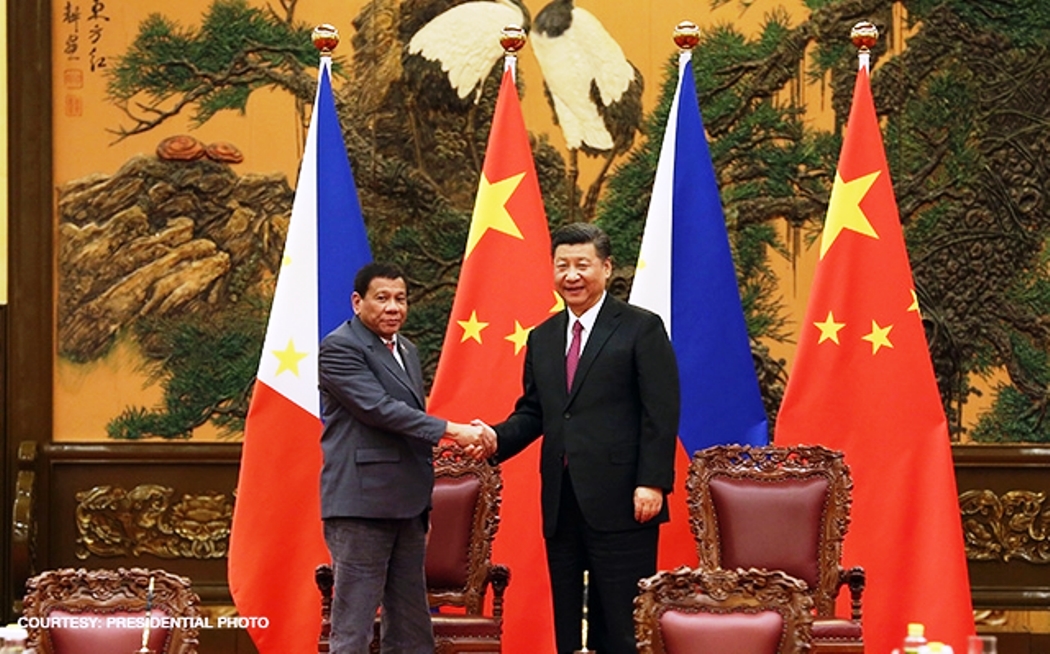
Philippine President Rodeigo Roa Duterte meeting with Chinese President Xi Jinping cooling down the tension in South China Sea and promised cooperation, progress, peace and stability of the Asian Region.

According to a June 2 Duran.com report, retired Philippine military official Abe Purugganan claims ISIS violence in Mindanao is part of an opposition Liberal Party plan to undermine Duterte and oust him from office – citing information from a party whistleblower.

Below are the comments The Duran posted, saying:

“There is a lot of noises and chatters flooding the cyberspace, you got to use your discernment to filter all these information.”

“LETS PLAY FIRE WITH FIRE,” explaining “(t)hese are the exact words stated by Loida Lewis and her fellow oligarchs on a meeting months ago with Liberal Party members abroad,” adding:

Their plan is to use ISIS or ISIS-connected terrorists to instigate violence and chaos in Mindanao, wanting Duterte’s government destabilized and ousted.

If the information reported is accurate, it explains what’s now going on, likely to worsen, perhaps spread to other parts of the country.

Last week, Duterte said

“if I cannot confront (ISIS terrorists threatening the country), I will resign. “If I am incompetent and incapable of keeping order in this country, let me step down and give the job to somebody else.”

If US dirty hands are behind the ISIS insurgency, he’s got a long struggle ahead, trying to overcome the attack on him and perhaps Philippine sovereignty.

Stephen Lendman lives in Chicago. He can be reached at lendmanstephen@sbcglobal.net.
His new book as editor and contributor is titled “Flashpoint in Ukraine: How the US Drive for Hegemony Risks WW III.”

http://www.claritypress.com/LendmanIII.html

Visit his blog site at sjlendman.blogspot.com.

The original source of this article is Global Research
Copyright © Stephen Lendman, Global Research, 2017

IS dead bodies recovered in Marawi includes European, Saudi, Yemeni, Indian, Malaysian & Indonesian

Blood stains the roadside as civilians view unidentified bodies believed to have been executed and dumped in a ditch by militants
Blood stains the roadside as civilians view unidentified bodies believed to have been executed and dumped in a ditch by militants.  Photo: Getty Images

Islamic State fears grow as foreign fighters among bodies in Philippines

Foreign IS fighters were among the militants who besieged a southern Philippines city, intensifying fears that Islamic State is gaining a foothold in South-east Asia.

Bodies found in Islamic City of Marawi, 830 kilometers south of Manila, after almost a week of fighting include Malaysians, Indonesians, Saudis, an Indian, Yemeni and Chechen an eastern European citizen, according to Rohan Gunaratna, a terrorism expert from the S. Rajaratnam School of International Studies in Singapore.

The Mindanao Island of the Philippines is now Islamic State's epicentre in the region, he said.

Zachary Abuza, another expert on terrorism in South-east Asia, said that while there is no evidence that Islamic State has sent significant support to a dozen militant Islamist groups operating in the southern Philippines, "increasingly South-east Asians are being drawn to Mindanao".

Australia and other nations in the region are so worried about the threat of homegrown IS militants returning from battlefields in Iraq and Syria that they have convened a summit in August to co-ordinate the threat.

Hundreds of battle-hardened fighters are expected to return to the region as IS loses ground in the Middle East.

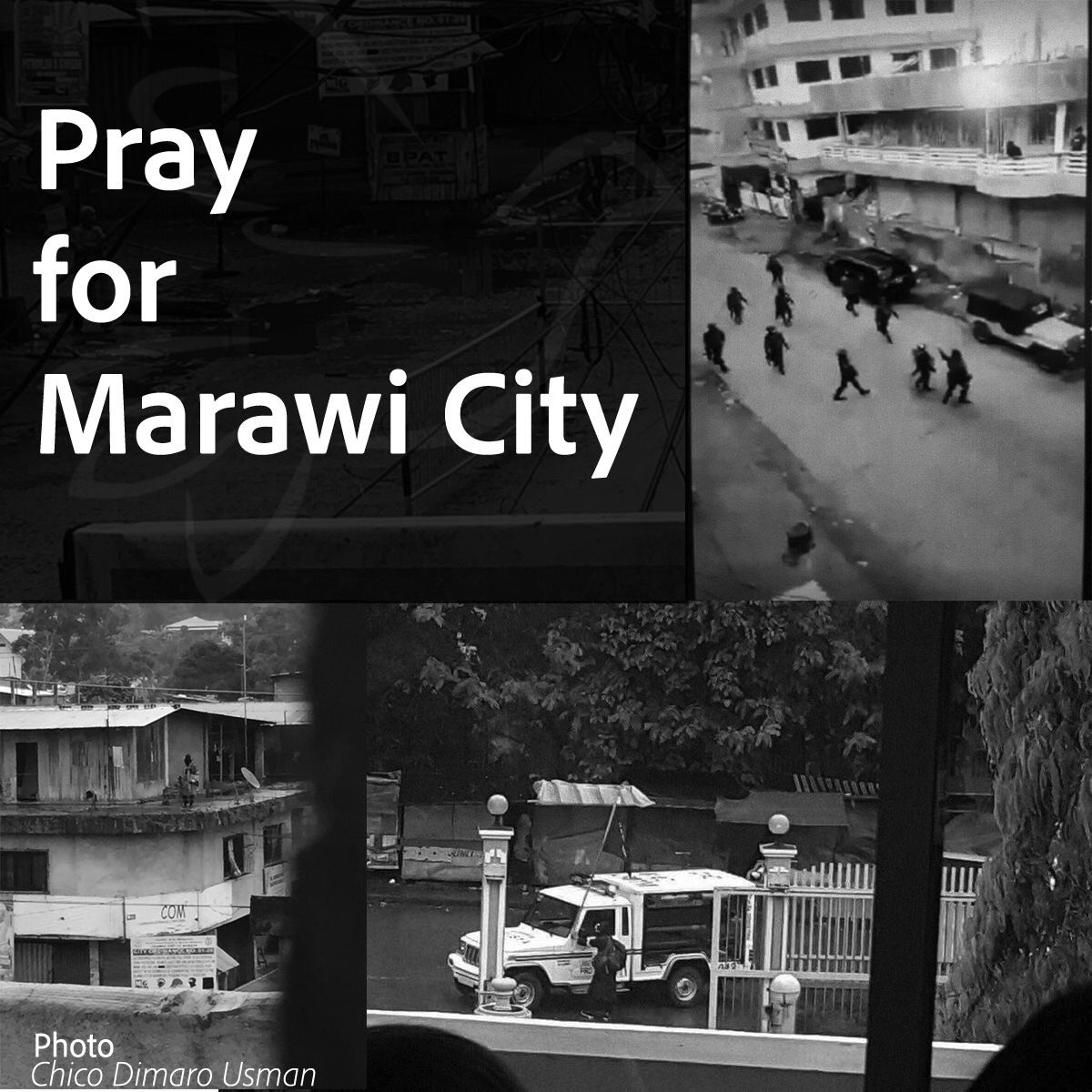
Pray for Marawi
#PrayForMarawi hashtag trending at social media right after the Maute Islamist group Attack Marawi City, the only Islamic City in the Philippines

Attorney-General George Brandis told a Senate committee earlier in May that the return of the fighters is "the issue which is of greatest concern to heads of government and homeland security ministers in the region when it comes to counter-terrorism".

The Philippines, which has in the past downplayed the threat from IS, has confirmed that foreign fighters have played a key role in the siege of the Islamci City of Marawi that has so far left more than 100 people dead and dozens wounded.

"What's happening in Mindanao is no longer rebellion of Filipino citizens. It has transmogrified into invasion by foreign terrorists who heeded the clarion call of the Islamic State to go to the Philippines if they find difficulty in going to Iraq and Syria," said Philippine Solicitor-General Jose Calida.

The militants flew black Islamic State flags during their rampage of the city.

Philippine President Rodrigo Duterte last week imposed martial law, giving security forces sweeping powers, while warning of the threat of "contamination" by IS in his island nation of 100 million people.

Dr. Gunaratna said IS has provided groups in the southern Philippines with propaganda, some foreign fighters and some financial transfers but not huge amounts of money.

"They are moving very slowly but very steadily," he said. "They are not in a hurry."

Professor Abuza, who has written a book about militant Islam in the region, said that while media attention has been on kidnappings and beheadings by the extremist Abu Sayyaf group, the bigger threat is to regional trade and commerce.

He pointed out that between March 2016 and April this year there were 19 separate sea attacks and hostage takings, resulting in the capture of 70 sailors and fishermen from six countries.

Professor Abuza said Abu Sayyaf is likely to continue to prioritize sea kidnappings, which involve low risk and high reward.

"Tug boats and fishing trawlers are very slow moving and undermanned. They are easy prey," he said.

The August summit is likely to decide on greater law enforcement cooperation and intelligence-sharing across the region.

Malaysia, Indonesia and the Philippines signed an agreement nine months ago for joint patrols in the Sulu Sea, but they have not begun. Read more at The Sydney Morning Herald

Philippines Rejects EU $278 Million USD Remote Control Fund Loan Grant

Philippines rejected EUROPEAN UNION $278 Million USD Remote Control Fund Loan Grant
Philippines rejected EUROPEAN UNION $278 Million USD Remote Control Fund Loan Grant for 2017

Philippines Rejects European grants

The Philippines will no longer accept grants from the European Union, the EU delegation to Manila said Thursday, following repeated tirades from President Rodrigo Duterte over its criticism of his deadly drug war.

"The Philippine government has informed us that they (will) no longer accept new EU grants," the delegation said in a brief statement.

The decision will affect grants worth 250 million euros ($278 million), according to Franz Jessen, the EU's ambassador to Manila.

Philippine government officials did not immediately comment, with the finance department saying a statement would be issued later on Thursday.

Duterte, 72, has repeatedly criticised European lawmakers and the EU for condemning his drug war, which has claimed thousands of lives and led to warnings from critics of a crime against humanity.

In comments last year, he used vulgar language and raised his middle finger in a response to a European parliament statement expressing concern over the killings.

The German government also expressed concern after Duterte last year drew parallels between his drug war and Nazi Germany leader Adolf Hitler's Holocaust.

"Hitler massacred three million Jews. Now there are three million drug addicts (in the Philippines). I'd be happy to slaughter them," Duterte said, underestimating the number of people killed in the Holocaust.

Duterte later apologised for the Hitler reference but said he was "emphatic" about wanting to kill addicts.

Duterte easily won presidential elections last year after promising to end crime by killing tens of thousands of drug traffickers and addicts.

Police have reported killing about 2,700 people since Duterte took office at the end of June and immediately launched his war on drugs.

Unknown assailants have killed more than 1,800 others, while about 5,700 other violent deaths are under investigation, according to police data.

Partly in response to American criticism of the drug war, Duterte has also loosened the Philippines' ties with traditional ally the United States.

He has instead embraced China, which has supported his drug war and sought to deepen economic ties by providing billions of dollars worth of investments and aid to the Philippines.

Duterte, a self-described socialist, has also forged warmer relations with Russia, and will travel to Moscow next week to meet President Vladimir Putin.

Read more at Sources: AP & SBS  

Philippines Making Great Progresses in Health Care for 92% Insurance- WHO

Philippine Health Insurance

Philippine Health Insurance coverage through PhilHealth riseup  to 92% to all Filipinos in 2017

PHILIPPINE HEALTH INSURANCE

The Philippines is chalking up improvements in the health-care sector, the World Health Organization (WHO) said, while pointing out that challenges remain for the country.

Dr Shin Young-soo, Regional Director for the Western Pacific of WHO, said statistics indicate that Filipinos now are living longer lives than before and this is largely due to collaborative efforts of the government, development partners and stakeholders.

“The Philippines has so many health achievements to celebrate: people born today can expect to live for more than 70 years. Innovative taxation schemes have pushed back unhealthy behaviors and tripled the health budget. More than 92 per cent of all Filipinos now benefit from national health insurance,” Dr Shin said.

Health care in the country has grown by leaps and bounds with more people getting access to medical maintenance services. In 1995, the Philippine Health Insurance Corporation (PhilHealth) was established. Its mandate is to provide health insurance coverage to all Filipinos.

As of 2014, 14.7 million families have been enrolled into the system through a full National Government subsidy.

But while the Philippines is making improvements in providing health-care coverage to more Filipinos, challenges remain for the country.

“The Philippines is a fast-growing economy undergoing profound societal transformation. However, with growth and changing lifestyles come challenges of non-communicable diseases,” Dr Shin said,

Health conditions linked to poverty remain. Some 30 per cent of Filipino children are malnourished and around 30 per cent of the population lack regular access to essential medicines.

“While health insurance coverage is high, out-of-pocket payments remain high, accounting for more than half of the country’s total health expenditure,” she said.

Dr Shin said the challenge for the country is how to sustain current achievements in health care will be the “heart of WHO’s work in the country in the next five years.”

WHO and the Philippines Department of Health (DOH) launched the Country Cooperation Strategy (CCS), a mechanism which defines WHO’s strategic framework and aligns it with national health policies and programs.

The focus of the WHO CCS 2017—2022 are five unique strategic priorities that include saving lives by ensuring full access to life-saving interventions, promoting the well-being of people by empowering them to lead healthy lives, protection from disasters and mitigating its effects on peoples’ health, optimization of health architecture and maintaining its integrity and use of platforms for health and support health in all settings, policies and sectors.

“In the coming six years, we look forward to continuing to work together as partners in health [care] for the more than 100 million people of the Philippines and the 1.9 billion people of the Western Pacific Region,” Shin concluded.

Philippines Newly Acquired First High-Tech Ambulance Hospital Ship for the Red Cross- Commissioned

MV Amazing Grace
The Philippine Red Cross’ first and only humanitarian ship, formerly a ferry owned by the Mat-Su Borough, will be used as a marine ambulance and disaster response vessel. (Philippine Red Cross via Facebook)

Troubled Mat-Su ferry gets a new name in the Philippines, leaving its checkered past behind

The former Mat-Su ferry known as Susitna has a new name: M/V Amazing Grace and recently commissioned in the Philippines.

That's the name bestowed upon the ferry after a naming contest conducted by the ferry's new owner, the Philippine Red Cross.

The organization revealed the name at a press conference Monday in Manila attended by Red Cross dignitaries from several countries including Japan, Germany and the United States. Philippine President Rodrigo Duterte on Tuesday christened what Red Cross calls the country's first and only humanitarian ship to be used as a marine ambulance and disaster response vessel.

The 198-foot vessel started its life as a U.S. Navy prototype acquired in 2011 by the Matanuska-Susitna Borough after the late U.S. Sen. Ted Stevens wedged an earmark into a Department of Defense spending bill.

Commissioning of MV amazing Grace Ship hospital
Philippine President Rodrigo Duterte, center, on Tuesday christened what Red Cross calls the country’s first and only humanitarian ship to be used as a marine ambulance and disaster response vessel. (Philippine Red Cross via Facebook)

The Susitna was transformed from a beach-landing barge with some ice-breaking abilities to a ferry at a Ward Cove shipyard. A $12.3 million federal grant paid for design, engineering and a $4 million ferry terminal at the borough port on Point MacKenzie.

But the high-tech vessel never left the dock, thanks to a combination of funding and political shortcomings.

The borough finally sold the ferry to the Philippine Red Cross last year at a loss: $1.75 million instead of the $6 million borough officials had originally sought.

Officials here liked to call the Susitna the borough's "free" ferry. It wasn't. A combination of grant matching fees, maintenance and repair costs tallied more than $10 million. The Federal Transit Administration in 2013 demanded Mat-Su repay the $12 million grant, but that has yet to be resolved.

The borough is still negotiating with the Federal Transit Administration to lower the grant repayment, borough manager John Moosey said this week. Read more at ADN


UN Rapporteur Agnes Callamard Speeh Makes her Incompetent for Concluding Philippines War on Drug based on hearsay

UN Rapporteur Agnes Callamard Acting as Big Bully in the Philippines

Callamard acting as local Opposition Political Party leader in the Philippines

United Nations Special Rapporteur Agnes Callamard’s early Friday Wikipedia information described her as highly paid consultant of the Philippines' opposition “Liberal Party” as she concluded her speeches without proper investigation but just taken the reports that were provided most from the liberal party groups who opposes the war on drugs in the Philippines.

Invited by the government to investigate the issue on EJK last September 2016 but refused to come and instead make a surprise visit to the Philippines to utter her conclusion against the Philippines War on Drugs without conducting a ground investigation to confirm the allegations.

Callarmard surprise visit to the Philippines is acting like a leader of the local political party to destroy the image of Duterte based on hearsays.

Malacanang on Calamard Surprise Visit

United Nations Special Rapporteur on Extrajudicial, Summary, or Arbitrary Executions Agnes Callamard is now in no position to launch an independent study on the spate of drug-related killings in the country after she talked against the war on drugs at a forum in Quezon City, a Malacañang official said on Friday.

Chief presidential legal counsel Sec. Salvador Panelo told reporters Friday that Callamard already made a conclusion based on news reports, some videos, opinions of critics, and hearsays.

“First, how did she know that that’s the way the drug operations are being conducted? What’s the basis?” Panelo said.

“She just cannot come here and read newspaper reports and hear the talks of some critics and watch some videos and make a conclusion that there is something wrong the way this government is doing its job,” he added.

Panelo said that how Callamard arrived at her conclusion was more important than the circumstances of her visit in the Philippines—whether it was on her own or through an invitation.

“What I’m questioning is the basis of her conclusion, which is based on hearsay and some reports coming from whoever and from wherever. It’s not an independent study. It’s not an objective study. It’s just a conclusion on the basis of things that she heard,” Panelo said.

But Panelo indicated that the Philippine government’s invitation to Callamard was already pointless when she already made her mind on the war on drugs.

“Alangan naman pilitin siya kung ayaw niya eh. Not only that, you know, the fact alone that she already made conclusions, I don’t think she would be competent enough or objective enough to undertake any study. She already made a conclusion, on the basis of hearsay and reports and whatever,” Panelo said.

“She was saying she read reports, she saw some videos, and on the basis of that, she made a conclusion that the operation against the drug menace in this country is wrong. How can she make that kind of conclusion when she only read the reports of some people and saw some videos?" he added.

"She has to make an independent probe or investigation on what’s happening in this country. This is precisely why the President invited her to come over. But she never responded to that," Panelo said.

While Callamard earlier said that the terms the Philippine government presented for her visit were against their Code of Conduct, Panelo said it was only fair that President Rodrigo Duterte would be able to question her conclusion.

"What the President just wanted to say after the investigation is, ‘Tell us, what’s the basis of your investigation?’ What’s wrong with asking someone making an investigation, ‘This is our conclusion.’ Then the President, ‘How did you make that conclusion? Who are the people you asked? How did you come about?’" Panelo said.

"I don’t think that’s unfair. That’s a very fair response from someone who has been investigated," he added.

International Court of Justice (ICC) whom claimed to have the authority for extrajudicial killings cases around the world has been labeled as International Caucasian Justice by the African nations for its failure to file cases on Western and European countries that committed thousands extrajudicial killings while acting as superior in issuing verdicts to the African countries as mass murderer in a form of bullying  the small and poor countries.

Several African nations have left and vacated their seats at the United Nations for distrust and integrity issues of the UN for its unfair and selective justice in issuing verdicts.

88 Meters Korean Anti-Submarine Warship Offered to the Philippines for ₱5,000 Pesos Each a real deal?

Korean Pohang-Class Anti-Submarine Warship “Chungju PCC-762” Offered to Philippine Navy
Korean Pohang-Class Anti-Submarine Warship “Chungju PCC-762” Offered to Philippine Navy for $100 USD

88 Meters Korean Anti-Submarine Warship Cheaper than a Smart Phone: Philippines to buy three for ₱5,000 Pesos Each a real deal?

Korean Pohang-Class Anti-Submarine “Chungju PCC-762” which launched on 30th June 1984, commissioned on 1987 and was decommissioned on 27th December 2016 after 29 years of service in protecting Korean waters has been offered to the Philippine Navy by the Korean Government.

South Korea will transfer an ageing Pohang-class anti-submarine warship to the Philippines this year in return for just $US100 (₱ 5,000.00), boosting its capability to patrol vast maritime borders.
The 88.3 meters corvette type warship has a 1,200 tones displacement, speed of 32 knots (59 km/h), and capacity of 95 crews.

It could be fitted with armaments such as 2 x MM-38 Exocet, 1 OTO melara 76 mm/62 compact cannon, 2 x Emerlec 30 mm cannons, 4 x harpoon missiles, 2 x Nobong 40mm/70 twin cannons, 3 x Mark 32 triple torpedo tubes with 6 chung sang Eoes and 12 x mark 9 depth charges.

South Korea, next to USA for being the largest source of Philippine military hardware, from fighter jets, and patrol ships to armored vehicles and army trucks.

USA has provided almost the same armament to the Philippines in 2013 but unlike the Pohang Anti-submarine warship which cost the Philippines only $100 USD, the Hamilton Class cutters from the USA cost the Philippine government a hefty $10 Million US Dollars.

Philippines received ten FA-50 light fighters from Seoul and two more will be delivered next month to complete the 12 aircraft, 18 billion peso deal.

The Philippines has expressed interest to acquire six more similar planes.

"We are hoping to receive the vessel within the year," defense spokesman Arsenio Andolong said of the warship.

"The transfer will be in the form of a donation. We will pay a token $US100, but the corvette will still undergo refurbishment."

He said he has no idea how much the Philippines would need to spend to repair and restore the warship.

Andolong said the Philippines may acquire up to three such warships, which Seoul is replacing with newer and faster vessels.

"This may be an old ship but it will definitely enhance our capability to patrol our waters and perform counter-terrorism measures," he added.

South Korea has donated a lot of military hardware to the Philippines and has expressed gratitude for Manila's role in the 1950-53 Korean War.

How America Failed the Philippines?

Washington pushed the Philippines away by failing to honor moral, if not legal, obligations to its long-standing ally
Washington pushed the Philippines away by failing to honor moral, if not legal, obligations to its long-standing ally.

“As published by the National Interest -  said Philippine president Rodrigo Duterte in October to his Chinese hosts, referring to America. “So I will be dependent on you for a long time.”

Within months of taking office, Duterte had accomplished the inconceivable, reorienting his country away from its only protector, the United States, and toward its only adversary, China. It is China that grabbed Mischief Reef from Manila in the first half of the 1990s and seized Scarborough Shoal in early 2012. The United States is the only nation pledged to defend the territorial integrity of the Philippines.

Some in the Washington policy community, upset with the flagrant display of disloyalty of the Philippine leader, said it was time to end the mutual-defense treaty with Manila. Yet the fundamental issue is not the firebrand Duterte. The issue is Washington. Washington did much to push Duterte away by failing to honor moral, if not legal, obligations to its long-standing ally. The Philippine president did not have to provoke America as he did in October during his trip to Beijing. But his words, though extreme, were nonetheless a predictable outcome of a misguided U.S. policy. It is unlikely that Duterte is spouting off against Washington to get a better deal, playing the Americans off the Chinese and Russians.

His many outbursts against the United States, in fact, look genuine, rooted in a century of Philippine nationalism and mistrust. Duterte was schooled in anti-Americanism from an early age. His grandmother, a Muslim, taught him that the United States was guilty of grave crimes during its colonization of the Philippines. To this day, he refers to the 1906 massacre of the Muslim Moros and believes Washington has not atoned for this particular instance of brutality or, more generally, the torture of Filipinos and the subjugation of his country. To make matters worse, Duterte then learned politics in university in the 1960s from Jose Maria Sison, the founder of the Communist Party of the Philippines. The president now proudly calls himself a leftist.

All these factors mean that America, in Duterte’s eyes, can never do anything right. He still rails about being denied a U.S. visa early last decade. Moreover, he won’t stop talking about what he perceives to be a violation of Philippine sovereignty, the mysterious disappearance of “treasure hunter” Michael Meiring from Davao City in May 2002 after the detonation of a bomb in his hotel room. Duterte, the mayor of that city at the time, believes that Meiring was whisked out of the country by the Central Intelligence Agency.

So not too many Filipinos were taken aback when Duterte slung a homophobic slur at then ambassador Philip Goldberg in August and, by some accounts, directed an equally derogatory comment in the direction of President Barack Obama the following month. As a close aide to Duterte characterized his virulent anti-Americanism, “It’s policy, personal, historical, ideological, et cetera, combined.”

Although Duterte’s views appear warped by prejudice, he nonetheless has good reason to complain about Washington, which despite its mutual-defense pact has not protected his country adequately. Manila has unsuccessfully attempted, since at least the late 1980s, to compel the United States to confirm that the treaty, signed in 1951 and ratified the following year, covers the reefs, rocks, shoals, atolls and islets Manila claims—and China covets—in the West Philippine Sea.

 BEIJING, WHICH calls that expanse by its more common name, the South China Sea, claims the same features. Its official maps contain nine, and sometimes ten, dashes forming an area called the “cow’s tongue.” Inside the tongue-shaped area is about 85 percent of that critical body of water, and Beijing claims sovereignty over every feature there. Moreover, official Chinese state media has recently used language directly suggesting that all the waters inside the dashes are sovereign as well. Beijing now has a term for all this: “blue national soil.”

The United States does not take sides on the many South China Sea territorial disputes—China’s claims also conflict with those of Taiwan, Malaysia, Brunei, Indonesia and Vietnam—but Washington does insist on peaceful resolution. Beijing’s actions, however, have been anything but peaceful. For instance, it seized Mischief Reef in a series of acts beginning in 1994. The feature is far closer to the Philippines than other claimants—Hanoi and Taipei as well as Beijing—but Washington did nothing to reverse the Chinese action. American policymakers at the time adopted a serves-them-right attitude because Manila, gripped by one of its bouts of nationalistic fervor, had just ejected the U.S. Navy from its facilities in Subic Bay and the U.S. Air Force from the nearby Clark Air Base.

In early 2012, China moved again. After the Philippines detained Chinese poachers taking endangered coral, giant clams, sea turtles and baby sharks around Scarborough Shoal, Chinese vessels swarmed the feature, which sits only 124 nautical miles from the main Philippine island of Luzon and about 550 nautical miles from China. The shoal—just rocks above the waterline—is strategic because it guards the mouths to Manila and Subic Bays.

China at the strategic speck employed its “cabbage strategy.” By wrapping the shoal “layer by layer like a cabbage” with small vessels, Maj. Gen. Zhang Zhaozhong explained, Beijing could exclude others. In June of that year, Washington brokered an agreement for both sides to withdraw their craft, but only Manila complied. Beijing has been in firm control of the feature since then.

Washington policymakers, despite the seizure, decided to let the matter drop. As Doug Bandow of the Cato Institute suggested, no American president could convince the public to defend “uninhabited rocks of no intrinsic importance.” And as a “senior U.S. military official” told the Washington Post in 2012,

I don’t think that we’d allow the U.S. to get dragged into a conflict over fish or over a rock. Having allies that we have defense treaties with, not allowing them to drag us into a situation over a rock dispute, is something I think we’re pretty all well-aligned on.

In short, the United States did nothing to hold China accountable for its deception. By doing nothing, however, America empowered the most belligerent elements in the Chinese political system by showing everybody else in Beijing that aggression works.

Months after taking control of Scarborough, an emboldened Beijing pressed forward by rapidly stepping up incursions around the Senkaku Islands in the East China Sea, claimed by China but under the control of Japan. And Beijing continued to apply pressure in the South China Sea, especially at Second Thomas Shoal, like Scarborough, thought to be part of the Philippines. At Second Thomas, Manila in 1999 grounded the Sierra Madre, a World War II–era hospital ship, to mark the shoal, and left a handful of marines on board. China, once again employing cabbage tactics, used small craft to surround the tiny Philippine garrison. In March 2014, Chinese craft escalated by turning back two of Manila’s resupply vessels, cutting off the troops stationed on the rusting hulk. “For fifteen years we have conducted regular resupply missions and personnel rotation without interference from China,” said Philippine Department of Foreign Affairs spokesman Raul Hernandez at the time.

 THERE ARE various theories why Beijing decided to act at that moment. Ernest Bower of the Center for Strategic and International Studies told Reuters that the belligerent Chinese move could have been the result of Beijing’s perception of American weakness in Syria and Ukraine. Yet there is a far more direct explanation. The Chinese knew the United States had remained idle when they grabbed the much-closer Scarborough, even though they had brazenly repudiated the agreement Washington had brokered with themselves and Manila.

In early 2014, Beijing began another provocative initiative by island building—cementing over coral—in the Spratly chain of islands in the southern portion of the South China Sea, creating more than 3,200 acres on and around seven reefs, rocks, shoals and specks. Beijing, most notably, rebuilt Fiery Cross Reef, also claimed by Manila as well as Taipei and Hanoi. The commander of U.S. forces in the Pacific, Adm. Harry Harris, called the newly created features China’s “great wall of sand.”

Moreover, the Chinese have continued provocative conduct. In February 2016, Chinese craft harassed a Philippine navy vessel not far from Half Moon Shoal, just sixty nautical miles south of Palawan, one of the main Philippine islands. And at about the same time, Beijing made an apparent move on uninhabited Jackson Atoll, which also sits off Palawan. Chinese vessels, following the Scarborough and Second Thomas playbooks, had for weeks crowded around the feature, which Beijing calls Wufang Jiao. China’s Foreign Ministry said Chinese craft had worked to free a grounded foreign vessel, a Manila-based fishing boat.

Yet the action was not a temporary effort to aid navigation, as Beijing had claimed. Chinese vessels, both white-hulled (coast guard) and gray-hulled (navy) had swarmed the feature and excluded Filipinos from their traditional fishing grounds. The Philippine Star, a Manila newspaper, called the Chinese ships a “menacing presence.” Eugenio Bito-onon Jr., a mayor in the area, said China’s ships had loitered around the atoll for more than a month. “We can’t enter the area anymore,” an unidentified Philippine fisherman told the Star. Up to five gray and white hulls had been stationed in the area “at any one time.”

“This is very alarming,” Bito-onon told Reuters. To inhabitants of the surrounding area, Beijing’s actions were a threat. “The Chinese are trying to choke us by putting an imaginary checkpoint there,” the mayor said. “It is a clear violation of our right to travel, impeding freedom of navigation.” Freedom of navigation has had no more staunch defender than the United States, but in recent years America has been reluctant to confront China as it attempted to restrict others in its peripheral waters. Washington’s abandonment of Manila was especially evident when an arbitral panel in The Hague handed down its landmark decision in Philippines v. China last July, invalidating the nine-dash line and ruling against China on almost all its positions.

The tribunal held that Mischief Reef and Second Thomas Shoal are within the Philippine exclusive economic zone and on the Philippine continental shelf, and that there was no basis for any claim by Beijing to these two features. With regard to Scarborough, it decided China had violated the traditional fishing rights of Filipino fishermen by exercising control of the shoal. Moreover, the panel ruled that Beijing had operated its vessels at Scarborough so as to create a “serious risk of collision and danger to Philippine ships and personnel,” breaching its international obligations. The Philippines, as a signatory to the UN Convention on the Law of the Sea (UNCLOS), brought the action in 2013, shortly after the Chinese had seized Scarborough. At first, Beijing did not realize the significance of the case filed by Benigno Aquino, Duterte’s immediate predecessor, but China eventually grasped its importance and contested the jurisdiction of the arbitral panel in December of the following year.

Beijing did not accept arbitration delimiting sea boundaries when in 1996 it ratified UNCLOS. Yet its ratification implicitly accepted arbitration of other matters. In October 2015, the arbitration panel asserted jurisdiction over seven of the fifteen claims raised by Manila. In response, China withdrew and did not participate in the substantive phase of the case.

Beijing denounced the 479-page award issued last July. It called the panel a “law-abusing tribunal,” the case a “farce.” The decision “amounts to nothing more than a piece of paper.” “The Ministry of Foreign Affairs of the People’s Republic of China solemnly declares that the award is null and void and has no binding force,” Beijing announced on the day it was issued. “China neither accepts nor recognizes it.” Chinese experts, apparently speaking at the behest of their government, threatened war.

And Duterte, who assumed the presidency two weeks before the decision was handed down, had grounds to be even more upset at America. Secretary of State John Kerry did say China should accept the award, but he spoke without seriousness. He did not pressure Beijing to honor its obligation to accept the ruling, but instead leaned on Manila to bargain with China, backing the Chinese position on starting talks. Kerry’s posture was indefensible. Chinese officials had publicly refused to accept the award as the basis for negotiations. The secretary of state, it was clear, was more intent on avoiding confrontation with a lawless Beijing than upholding centuries of U.S. commitment to defend the global commons.

Duterte, among others, has noticed Washington’s reluctance to protect his beleaguered country. “America did nothing,” he said in October 2015, referring to China’s reclamation activity. “And now that it is completed, they want to patrol the area. For what?” His views on the topic have been nothing if not consistent. America, he maintained at the end of December, should have stopped China “when the first spray of soil was tossed out to the area.” “He feels aligning with our allies against China is not going to benefit the country,” said Jesus Dureza, Duterte’s close friend and cabinet-level peace adviser, describing the president’s views. “The idea is that our allies are not going to go to war for us, so why should we align with them?”

Perfecto Yasay Jr., Duterte’s foreign minister until March, expanded on this theme of betrayal. He noted the “stark reality” that the Philippines cannot defend itself and, in a Facebook post aptly titled “America Has Failed Us,” wrote,

Worse is that our only ally could not give us the assurance that in taking a hard line towards the enforcement of our sovereignty rights under international law, it will promptly come to our defense under our existing military treaty and agreements.

Moreover, Duterte has also made it clear he will not side with America because he believes that in East Asia it has already “lost,” something he made clear during his Beijing trip.

THE UNITED States has by no means lost in any sense of that term, but nuanced, hesitant-looking U.S. policies have created that impression. Washington, throughout the Bush and Obama administrations, inadvertently created the appearance of weakness, and the appearance of weakness is now costing Washington a crucial treaty ally. As Duterte, who obviously prides himself on his strength, makes clear, everyone wants to be on the winning side.

There are, however, several signs that the rift between Manila and Washington can narrow in coming months. First, American policies are moving in a direction more to the liking of the Philippines. The trend began sometime around the beginning of last year. “Early 2016 saw a perceptible uptick in American naval patrols and surveillance activities close to the Scarborough Shoal, which may have contributed to China’s decision to postpone any construction activity on the disputed feature,” Richard Heydarian, a foreign-affairs expert in Manila, told me.

Moreover, the Financial Times reports that last March, President Obama privately warned Chinese ruler Xi Jinping that he would do all he could to prevent the reclamation of Scarborough—“a stark admonition,” as the paper put it—and there are indications Obama repeated the stern words during the G-20 meeting in September in the Chinese city of Hangzhou. American efforts, Manila believes, had some effect. This March, Defense Secretary Delfin Lorenzana publicly suggested that Washington stopped China at the last minute from cementing over Scarborough. President Trump looks like he will continue to move in his predecessor’s more resolute direction. During his January confirmation hearing, Secretary of State Rex Tillerson stated that China would not be allowed to occupy its reclaimed features in the South China Sea. Moreover, White House spokesman Sean Spicer reiterated Tillerson’s position when he said that the administration would not permit China to grab disputed features. “Under Trump, there is growing confidence that the U.S. will adopt a more robust stance against China,” Heydarian notes about attitudes in the Philippine capital.

The new direction is the product of a realization that, for its own reasons, Washington must stop China from reclaiming and militarizing Scarborough. Militarization would allow the People’s Liberation Army to complete a triangle formed by the airstrip on Woody Island in the Paracels and the three runways on the seven reclaimed islands in the Spratly chain. The interlocking facilities would give Beijing the ability to enforce an air-defense identification zone over the South China Sea, much like the one it declared over the East China Sea in November 2013. Each year, some $5.3 trillion of goods passes on and over the South China Sea—much of it moving to or from the United States—so Washington does not want any other country, especially China, to control the skies over that crucial body of water.

Moreover, there is a sense in Washington that, as Beijing adopts progressively more hostile policies, it must keep China’s navy and air force penned inside what Chinese strategists call the “first island chain.” The Philippine president, who governs a sprawling archipelago in the center of that chain, could give China’s forces easy access out of the South China Sea to the Western Pacific, thereby exposing, among other things, Taiwan and the southern portion of Japan.

Second, nations other than the United States also have an interest in preventing the Philippines from becoming a Chinese dependency. Both South Korea and Japan are critically reliant on tanker shipments from the Middle East crossing the South China Sea. Seoul, now embroiled in a deepening political crisis, has no time for outreach to the Philippines. Tokyo, on the other hand, is working the problem hard. Its prime minister, Shinzo Abe, was the first head of government to pay a call to the country since Duterte took office, traveling to see the Philippine leader at his home in Davao City in January. Abe’s trip followed that of his foreign minister, Fumio Kishida, who was the first foreign minister to go there during Duterte’s administration.

In Duterte’s home, Abe shared a simple breakfast in the kitchen, and the Japanese leader brought gifts. Not only is Tokyo funding a drug-rehabilitation center—thereby helping the Philippine leader with his most important domestic initiative—it is also pledging $8.7 billion in assistance. Money talks loudly in Manila and helps Japan, a staunch U.S. ally, maintain a vital link between Washington and its most troublesome treaty partner. Tokyo, in short, may be the factor keeping Duterte from a final defection to China.

Third, Beijing will also impede Duterte from completing his pivot to China. After all, the Philippines, whether it publicly admits to it or not, is involved in a zero-sum contest with the Chinese state. Beijing now labels its South China Sea claims as “core” and “irrefutable,” and Duterte, although he can make temporary accommodations on issues like fishing rights, cannot compromise sovereignty. If he cedes territory as Beijing demands, he could lose his job. In October, on the eve of the president’s trip to Beijing, Supreme Court Senior Associate Justice Antonio Carpio remarked that Duterte can be impeached if he surrenders Scarborough Shoal. Duterte may say China “has never invaded a piece of my country all these generations”—what he told the Chinese during his October visit—but that is manifestly untrue. And Beijing is ramping up efforts to dominate specks that Filipinos believe are theirs.

Fourth, many in Manila are concerned about Duterte moving the Philippines into the Chinese sphere of influence. Among the pro-U.S. voices is the influential Fidel Ramos, a former president. Ramos, who has counseled Duterte, called his anti-U.S. statements “discombobulating,” and there is general concern in the Philippine capital about anti-Americanism getting out of control. The Philippine military, which has seen fit to change presidents from time to time, is almost uniformly pro-American.

These attitudes are in line with Philippine popular opinion. Poll after poll indicates general support for America, usually around 90 percent. No country, as the last Pew Research Center survey notes, has a more favorable view of the United States than the Philippines. And, predictably, poll after poll indicates that the Philippine public expects Duterte to defend the country’s sovereignty. A recent Pulse Asia survey showed that 84 percent of Filipinos want Duterte to assert rights over South China Sea features, in accordance with the July 12 Hague ruling. In a response to growing public concern, Foreign Minister Yasay revealed in January that he had filed formal protests with Beijing over its activities at Scarborough and in the Spratly chain. read more at the National Interest

Russia Warship in the Philippines for Joint Exercise; Draft for Defense Agreement for Duterte Visit may 25

Dream Meaning OF WEARING BLUE OR PURPLE
Naval Group of Russia's Pacific Fleet Makes Port Call in Philippines' Manila for 4 days- First Joint Excercise

Philippines – Russia First Joint Exercise

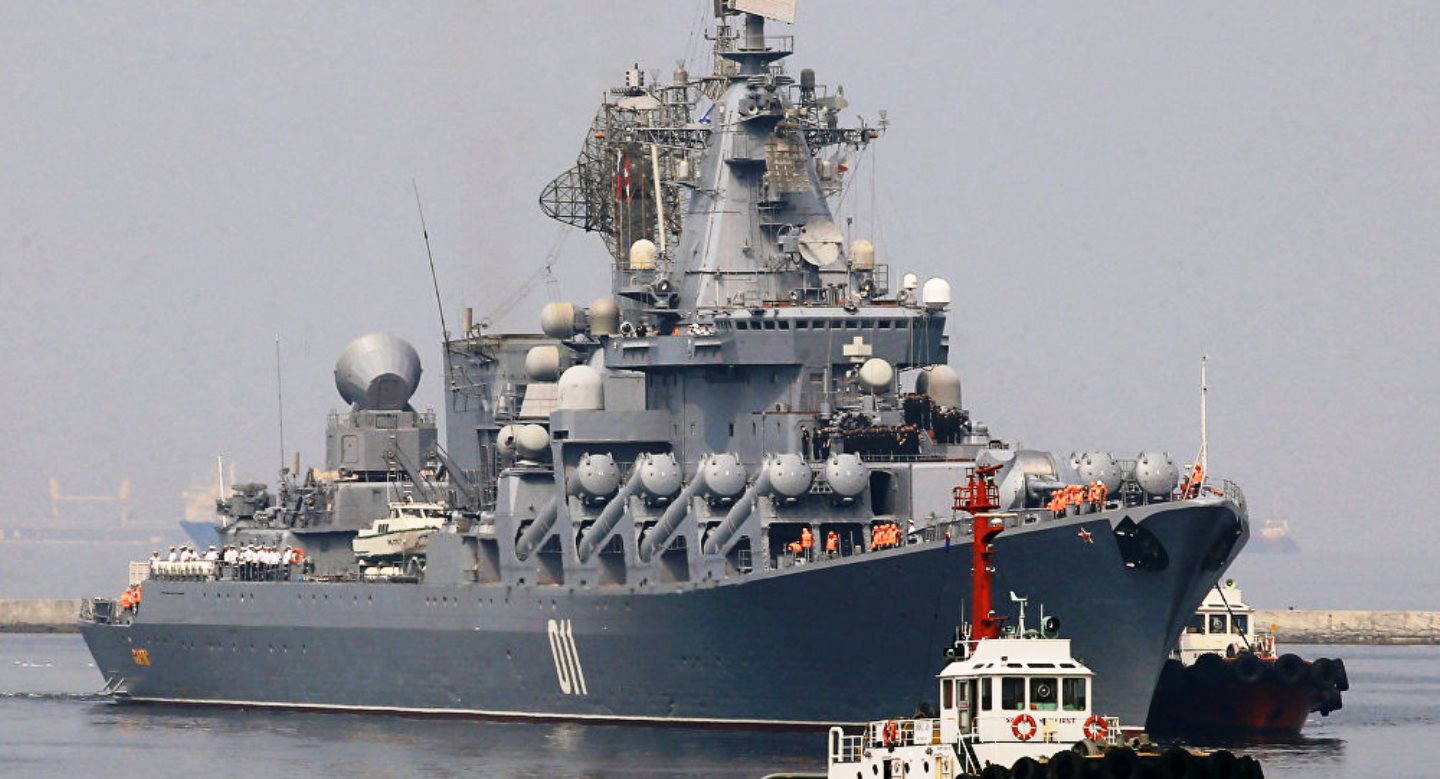
Russian Warship arrived in the Philippines on Thursday for joint exercises as part of a drive for new security ties under President Rodrigo Duterte's revamped foreign policy of courting the traditional foes of Manila's top ally, Washington.

The guided-missile cruiser Varyag, accompanied by the fuel tanker ship, Pechenge, are on a four-day goodwill visit to the Philippines, the second port call by Russian warships in three months.

The move is part of what Duterte describes as a pursuit of a constitutionally mandated "independent foreign policy". He has made no secret of his grudge against the United States and has made befriending Russia and China the priority of his diversification drive.

Captain Lued Lincuna, director of the Philippine navy's public affairs, said the Philippines hoped to learn from the Russians during training activities and a demonstration of advanced equipment and weapons systems.

The schedule includes training and sports activities with the flagship vessel of the Russian Pacific fleet, plus a Russian concert in a park.

Video: Naval Group of Russia's Pacific Fleet Makes Port Call in Philippines' Manila for 4 days- First Joint Excercise

Philippines – Russia Defense Agreement

Russian commander Captain Alexsei Ulyanenko said the port call would make a "significant contribution" to strengthening relations and maintaining stability in the region.

Moscow wants to help Manila combat extremism and piracy, stepping up cooperation and training in areas where the Philippines has traditionally worked closely with its former colonial master the United States.

The relationship is expected to develop further next month when Duterte and Russian counterpart Vladimir Putin witness the signing of defense agreements in Moscow.

When Duterte met Putin for the first time last year, the Philippine leader spoke at length about what he called U.S. "hypocrisy".

Duterte has instructed his defense minister to look into how the Philippines could acquire modern military equipment from Russia, like drones, night-vision gear, sniper rifles, and even helicopters.

Duterte to visit Russia on May 25

President Rodrigo Duterte will be visiting Russia on May 25.

During his speech at the induction of newly elected officers of the Cebu Chamber of Commerce and Industry Inc., Duterte said Armed Forces of the Philippines Central Command chief Army Major General Oscar Lactao will be joining him.

"So I'm going there with Lactao, May 25," Duterte said. "[Sabi ko sa kanya,] Maganda rin ang mga Russian. Iyon lang man ang puntahan mo. Usap kami ni Putin."

[Translation: I told Lactao, "Russians are also beautiful. At least go with me for that." Putin and I will talk.]

He also reiterated Russia's commitment to helping the Philippines.

"Sabi pa ng Russia [said], "We will have everything you need, just come here,"" he added.

Improved Philippine-Russian relations

Russian Ambassador to the Philippines Igor Khovaev told CNN Philippines' "The Source" in January that Duterte's visit to Russia is a "milestone" in the ties between the two nations.

"Both the Russian and Philippine side, we need to prepare substantial and solid package of bilateral agreements on cooperation in different fields, and we are now taking necessary efforts," Khovaev said.

He also said Russian companies are willing to explore Philippine markets. He urged Philippine companies to reciprocate and explore the Russian market as well.

"We are ready to cooperate in industries of transport, energy… including the use of nuclear energy for peaceful purposes, telecommunications, agriculture, and many other fields. Both sides have a lot to offer," Khovaev said.

Economic, military agreements in the works

Economic ties between Manila and Moscow are at their infancy.

Russia has not had any foreign direct investment in the Philippines since 1999, central bank data showed.

Russia accounted for $43 million (around ₱2.17 billion) in overseas remittances last year, but it was only 0.2 percent of the total $26.9 billion (around ₱1.35 trillion) sent home by Filipinos from all over the world.

In addition, Socioeconomic Planning Secretary Ernesto Pernia said Russia committed to importing up to $2.5 billion (around ₱126 billion) worth of Philippine fruits, grains and vegetables in 2017.

Imports by Russia from the Philippines stand at $46 million (around ₱2.32 billion), according to government trade statistics.

Beyond economic links, the Philippines is also eyeing military cooperation with Russia. Defense officials have said they were looking into possible joint exercises and weapons deals with the Kremlin.

Building trust

In addition, Khovaev said he is optimistic that Filipinos would trust Russia more as the two countries build bridges.

"It's time for Filipinos to discover Russia, and vice-versa… and I have a strong belief, we'll trust each other." he said.

In a non-commissioned survey released by Pulse Asia on January 12, 38 percent of Filipinos trust Russia, while 58 percent do not.

These figures are far behind that of the United States, which has a 76 percent trust rating.

"It's a good result if we take into account so many decades of Hollywood-style Russian propaganda in your country," he said, in apparent reference to prevailing perceptions of Russia as "communist" when it was formerly known as the Union of Soviet Socialist Republics.

The Philippines has long been known as an ally of the U.S., even after it was colonized by the superpower from 1898 to 1946..With reports from Channel News Asia and CNN Philippines

Duterte early lead in “TIME: No. 1 Most Influential Person in the Universe” VOTE NOW! For his Crown

Philippine President Rodrigo Roa Duterte takes early lead in TIME 100 pol Most inflential person in the universe
Philippine President Rodrigo Roa Duterte takes early lead in TIME 100 poll.

The TIME 100— annual list of the most influential people in the world—features a number of leading artists, politicians, lawmakers, scientists and leaders of tech and business. Although TIME's editors will choose the final list of honorees, we want readers to share their choices with us as well.

Did football player Colin Kaepernick or Oscar-winning filmmaker Barry Jenkins strike you as most influential this year? What about the Women's March co-chairs, Linda Sarsour, Tamika Mallory, Carmen Perez and Bob Bland? Or perhaps Steve Bannon or Kellyanne Conway, close advisers to President Donald Trump?

How about the Philippine' most popular President and  illegal drugs buster Hero "Rodrigo Roa Duterte"? will you cast your vote for him?

Cast your vote below. Voting closes at 11:59 p.m. E.T. on April 16, 2017, and the winner of the reader poll will be announced immediately after. This year's official TIME 100 list will be announced April 20.

VOTE HERE!

If you want Philippine President Rodrigo Roa Duterte to be crowned as Time 2017 most influential person in the Universe then give him an unrivalled VOTE just him alone. But if you want others to compete his crown then vote the others as well as his challenger. To vote click “YES” for approval and “NO” for disapproval or if you don’t like the candidate to be crowned as most influential person. Click START POOL


Your vote counts! just vote accroding to what your heart's says.

See Who Is Winning the 2017 TIME 100 Poll here 

2 TC-90 Japanese Jet be Transferred to the Philippines March 27 To Patrol Maritime Territory

TC-90 Japanese Jet be Transferred to the Philippines
2 of 5 leased Super King Air Beechcraft trainer jet left Japan's Tokushima Air Base Arriving the Philippines March 27

Two of the Five Leased T-C90 Japanese aircraft will be officially transferred to the Philippine Navy next week in a boost for Manila’s limited capabilities and an indicator of the significance of the bilateral defense relationship.

T-C90 Trainer jet is developed by Beechcraft Super King Air and is comprises of number of twin-turboprop models that have been divided into two families; the Model 90 and 100 series developed in the 1960s are known as King Airs, while the later T-tail Model 200 and 300 series were originally marketed as Super King Airs, with "Super" being dropped by Beechcraft in 1996.

The King Air was the first aircraft in its class and has been in continuous production since 1964. It has outsold all of its turboprop competitors combined. It now faces competition from jet aircraft such as the Embraer Phenom 100, Honda HA-420 HondaJet and Cessna Citation Mustang; as well as from newer turboprop aircraft including the Piaggio P180 Avanti, and single-engine Piper Malibu Meridian, Pilatus PC-12, and Socata TBM.

According to the Japan Ministry of Defense’s Acquisition, Technology, and Logistics Agency (ATLA), two Japan Maritime Self Defense Force (JMSDF) TC-90 training aircraft will be officially transferred to the Philippine Navy on March 27. In a confirmation on Monday, the agency said that the aircraft would leave on Tokushima Air Base on March 23, with an arrival ceremony to be held at Naval Base Heracleo Alano in Sangley Point, Cavite City.

It had also come shortly after both sides had inked a landmark defense equipment and technology agreement, which was just the fourth Tokyo had signed with any country. As I have pointed out before, though attention tends to be overly focused on the Philippines’ relationship with its treaty ally, the United States, Japan is another of the key security partners that Manila has been cultivating. Thus far, signs are that this is set to continue under Philippine President Rodrigo Duterte, despite discontinuities in other dimensions of foreign policy

Philippine officials have publicly admitted that the TC-90s would be a much-needed capability boost for the military, which remains one of Asia’s weakest. The planes have around twice the range of the existing Norman-Britten BN-2 Islander fleet, which the navy uses for patrol, surveillance, and humanitarian assistance and disaster relief and rapid assessment missions. They are also much faster. The aircraft can also be fitted with additional equipment such as basic surface and air surveillance radar that would make it useful on the South China Sea front.

The TC-90s will be used to augment the existing Norman-Britten BN-2 Islander fleet, which the Navy uses in patrol, surveillance and humanitarian assistance and disaster relief (HADR) and rapid assessment missions.

Last November, two Philippine Navy pilots and six air crews left for Japan to start their TC-90 flight training.

The Department of National Defense (DND) earlier announced that the Philippines will re-equip the TC-90s as Japan has stripped them of some equipment, including their surveillance systems.

The country will pay Japan $7,000 USD each for the first four aircraft yearly and only $200 USD for the fifth, for total of $28,200 USD as stipulated in its lease agreement.

The 5 TC-90 Beechcraft Super King Air which would be transferred to the Philippines for lease agreement are part of the active 40 TC-90 Trainer Jet in Japan leaving 35 active in the Japan Maritime Self-Defense Force (JMSDF) asset inventory.

The DND added it is also looking at the possibility of using the TC-90 for 20 years while the military is upgrading its equipment.

The TC-90, which is part of the Beechcraft King Air aircraft family, was offered by Japan shortly after the Agreement Concerning the Transfer of Defense Equipment and Technology was finalized Feb. 29 last year.

The TC-90’s patrol range is double that of a small Philippine aircraft, which only has a maximum range of 300 km.

In 18 Century- Europe Invaded China, 21 Century Asks Free Druglords in Philippines: Duterte SO ANGRY on EU's Requests: Give Shabu to Addicts, FREE the Drug Lords Selling Drugs

Opium War in Asia - Britain invaded China for arresting the druglords from selling Opium drugs, products of Britain
Opium War in Asia - Britain invaded China for arresting the druglords from selling Opium drugs, products of Britain. Photo: Nationalinterest.org


The War That Made Asia: How the Opium War Crushed China


European countries First Illegal Drug Trafficking to China led to “The Opium War, China’s Defeat”
In 1839, England went to war with China because it was upset that Chinese officials had shut down its drug trafficking racket and confiscated its dope.

Stating the historical record so plainly is shocking — but it’s true, and the consequences of that act are still being felt today.

The Qing Dynasty, founded by Manchurian clans in 1644, expanded China’s borders to their farthest reach, conquering Tibet, Taiwan and the Uighur Empire. However, the Qing then turned inward and isolationist, refusing to accept Western ambassadors because they were unwilling to proclaim the Qing Dynasty as supreme above their own heads of state.

Foreigners — even on trade ships — were prohibited entry into Chinese territory.

The exception to the rule was in Canton, the southeastern region centered on modern-day Guangdong Province, which adjoins Hong Kong and Macao. Foreigners were allowed to trade in the Thirteen Factories district in the city of Guangzhou, with payments made exclusively in silver.

The British gave the East India Company a monopoly on trade with China, and soon ships based in colonial India were vigorously exchanging silver for tea and porcelain. But the British had a limited supply of silver.

More War, More Opium:


Imperialism was on the upswing by the mid-1800s. France muscled into the treaty port business as well in 1843. The British soon wanted even more concessions from China — unrestricted trade at any port, embassies in Beijing and an end to bans on selling opium in the Chinese mainland.

One tactic the British used to further their influence was registering the ships of Chinese traders they dealt with as British ships.

The pretext for the second Opium War is comical in its absurdity. In October 1856, Chinese authorities seized a former pirate ship, the Arrow, with a Chinese crew and with an expired British registration. The captain told British authorities that the Chinese police had taken down the flag of a British ship.

The British demanded the Chinese governor release the crew. When only nine of the 14 returned, the British began a bombardment of the Chinese forts around Canton and eventually blasted open the city walls…. Read more at Nationalinterest.org


hilippine President Rodrigo Duterte has described European lawmakers as

Philippine President Rodrigo Duterte has described European lawmakers as "crazies" in a salty-tongued rebuttal to criticism of his deadly drug war, while vowing again that all traffickers will be killed. PHOTO: REUTERS


Duterte to EU: Stop meddling in Philippine affairs 


President Rodrigo Duterte once again hit back at the European Union (EU) for meddling with the issues of the Philippines.

"Why are you trying to impose on us?" he said in a speech Sunday at a meeting with the Filipino community in Myanmar, where he was on a two-day official visit.

"Why won't you mind your own business," he added.

Duterte's statements come after the European Parliament on Friday issued a joint resolution calling for the release of Senator Leila De Lima, who was arrested on February 24 on drug charges.

The President also responded to the body's suggestion that the ongoing drug war must go hand-in-hand with measures for prevention and detoxification, including the opening of new rehabilitation centers.

"This EU Parliament, prinopose nila lahat na lang na addicts, bigyan nalang," Duterte said. "Kung shabu, bigyan ng shabu. Kung cocaine, bigyan ka ng cocaine. Magpunta ka lang sa center."

[Translation: This EU Parliament is proposing that we just give drugs to addicts. If they're addicted to shabu, we should give them shabu. If they're addicted to cocaine, we should give them cocaine. They just need to go to the center.]

The government has moved into the second phase of its war on drugs by shifting towards reforming drug dependents by building more rehabilitation centers, Presidential Spokesperson Ernesto Abella said in October 2016.

Duterte and the EU


Duterte has chastised the EU since it criticized the war on drugs he launched in July 2016.

In September 2016, he challenged the United Nations and EU lawyers to come to the Philippines to prove their claims of alleged extrajudicial killings related to the drug war.

The President said he should be given the opportunity to be heard by them.

"In keeping with the time-honored principle of the right to be heard, matapos nila akong tanungin, tatanungin ko sila. Iisa-isahin ko sila," he said. "Manood kayo. Tignan niyo kung paano ko lampasuhin yang mga yawa na 'yan."

[Translation: In keeping with the time-honored principle of the right to be heard, I will ask them. Each one of them. You watch. Watch me discredit those idiots.]

In October 2016, Duterte challenged the United States and the EU to pull out their aid to the Philippines.

"If you think it is high time for you guys to withdraw your assistance, go ahead," he said. "We will not beg for it," Duterte said.

Meanwhile, EU Trade Commissioner Cecilia Malmstrom said at the ASEAN Economic Ministers' EU Trade Consultations earlier this month that the Philippines's human-rights record — from the war on drugs to the proposed reimposition of the death penalty — could be a sticking point in free-trade agreements between Philippines and the EU.

"The European Parliament and member-states have some concerns about this development," she said."We are discussing this with our partners in the Philippines."

Trade Secretary Ramon Lopez said if the EU doesn't budge on its allegations of alleged extrajudicial killings, the Philippines would not be swayed by conditions imposed on it by international bodies.

"If this drug war, the death penalty, are the best ways to respond to criminality, then that is what we must pursue," Lopez said. - With reports from The National Interest and CNN Philippines

Former U.N. General Assembly Hits Leni Robredo “IMPEACHABLE ACT”: Betraying Public Trust & Economic Sabotage

U.N. General Assembly Hits Leni Robredo “IMPEACHABLE ACT”
A former delegate to the United Nations General Assembly (UNGA) has assailed Vice President Leni Robredo for “misrepresenting” millions of Filipinos when she addressed the 60th annual meeting of the UN Commission on Narcotic Drugs via a video message that highlights alleged rights abuses in President Rodrigo Duterte’s so-called war on drugs. (Photo: Asian Journal )

Former UNGA delegate hits VP Robredo for ‘misrepresenting’ Filipinos


A former delegate to the United Nations General Assembly (UNGA) has assailed Vice President Leni Robredo for “misrepresenting” millions of Filipinos when she addressed the 60th annual meeting of the UN Commission on Narcotic Drugs via a video message that highlights alleged rights abuses in President Rodrigo Duterte’s so-called war on drugs.

“I am making this urgent appeal on behalf of each and every Filipino grossly misrepresented by our Vice President in the said video message, in reporting to the world what she failed to report to Philippine authorities,” said Michael Francis Acebedo Lopez, a Filipino and a former delegate to the UNGA.

Lopez noted that Vice President Robredo, whose own mandate has been called into question, with the country’s highest electoral tribunal considering the election protest against her win to be sufficient in both form and substance, “wantonly painted an impossibly grim image of the Philippine situation if only to attract international attention and action with unfounded claims and unsubstantiated allegations”.

Assuming there are actual reports received by the Office of the Vice President, Lopez said Robredo “has not only embarrassed our country, she has betrayed the public trust and committed economic sabotage, both punishable under Philippine laws”.

In the video, Robredo references the more than 7,000 people killed since the drug war began on July 1, 2016. The death toll has reportedly increased to 8,000.

“Our people have fought long for our rights and freedoms. We are not about to back down now,” she said.

Robredo also details in her video message other supposed human rights abuses occurring under the present administration — people beaten for requesting search warrants, and police detaining relatives in lieu of absconded drug suspects.

She also questions inconsistent figures on drug addiction reported by President Duterte.

Rather than a problem to be solved with bullets, Robredo said drug abuse “must be regarded as it truly is — a complex public health issue linked intimately with poverty and social inequality”.

In reporting to the world what the Vice President failed to report to Philippine authorities, Lopez said she “has not only embarrassed our country, she has betrayed the public trust and committed economic sabotage, both punishable under Philippine laws”.

“For her to say that ‘our people feel both hopeless and helpless’ is a brazen lie,” he said. “Confidence in the presidency is at an all-time high (while the same cannot be said of the vice president whose approval ratings continue to plummet). As a people, we feel hopeful and empowered like we’ve never felt before.”

“When the Vice President says 7,000 people have been killed in the President’s war on drugs, she fails to mention that this is set against the backdrop of around 700,000 to one million successful arrests and surrenders. So the figure she presents to you is not even 1 percent. And surely with the sheer number of those involved in the illicit drug trade, some police operations see suspects resisting arrest and fighting back and the police having to defend themselves resulting in casualties,” he noted.

“Every war has casualties. It is not a perfect war and I’m certain there have been abuses along the way, and these need to be looked into and those responsible must be brought to justice. But exaggerating things does not help at all.”

In responding to the call of the Vice President, Lopez said the international community “must tread carefully, lest it encroaches on our very sovereignty and our right to self-determination. And as a sovereign state, we have determined to wage an internal war (not a war against another nation) against the evils of drugs, a direction affirmed by our democratic processes when President Duterte, who included the war on drugs as one of his main programs of action, received an overwhelming mandate during the May 2016 Presidential Election. In short, the war on drugs, by extension, has the people’s mandate.”

“Any effort to disturb our democracy and sovereignty as a response to the Vice President’s irresponsible and unfounded claims will subvert the will of the Filipino people and violate our Human Right of Suffrage enshrined in both the Philippine Constitution and the Universal Declaration of Human Rights (Article 21 of the international covenant),” he stressed.

Lopez reiterated his appeal to members of the UN Body “to disregard the Philippine Vice President’s statement which is, I reiterate, a grave misrepresentation of the prevailing sentiments of our people and a gross perversion of the facts surrounding the war on drugs”.

“To my fellow Filipinos, let us remain vigilant in the face of threats to our democracy by the very people who claim to defend it,” he added. - By Lilybeth G. Ison of  Philippine Canadian Inquirer

Investment Recommendation: Bitcoin Investments

Live trading with Bitcoin through ETORO Trading platform would allow you to grow your $100 to $1,000 Dollars or more in just a day. Just learn how to trade and enjoy the windfall of profits. Take note, Bitcoin is more expensive than Gold now.


Where to buy Bitcoins?

For Philippine customers: You could buy Bitcoin Online at Coins.ph
For outside the Philippines customers  may buy Bitcoins online at Coinbase.com