Filipinos in South Korea
Showing posts with label Spratlys. Show all posts

PHOTOS: Philippines challenges China's Claim of West Philippine Sea at UNCLOS Tribunal in The Hague

Null

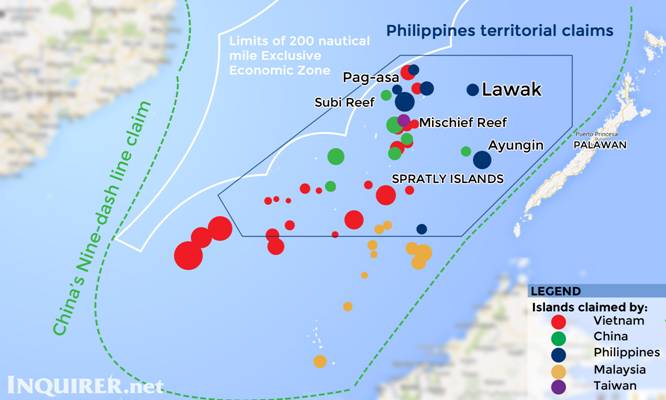
Philippines challenges China's Claim of country's exclusive economic zone at UNCLOS Tribunal in The Hague. image: inquirer.net

IN PHOTOS: Philippines challenges China in The Hague

In photos emailed to Rappler, the Permanent Court of Arbitration gives us a glimpse of the closed-door hearings pitting Manila against Beijing

MANILA, Philippines – Behind closed doors, the Philippines recently waged a legal battle against China in The Hague, Netherlands, in a historic case over the disputed West Philippine Sea (South China Sea).

The Philippines on Thursday, July 23, is set to submit a new document to The Hague to bolster its case.

While Manila pursues this, a question remains: What exactly happened during hearings from July 7 to 13?

The Permanent Court of Arbitration (PCA) in The Hague, which serves as the venue for the arbitration proceedings, emailed Rappler high-resolution photos to give us a glimpse of the closed-door hearings.

Null

China claimed the shores of Vietnam, Philippines, Malaysia, Indonesia, Brunei and Japan as their own

The photos show a powerhouse team, led by internationally acclaimed lawyer Paul Reichler, defending the Philippines' case before an equally high-caliber arbitral tribunal in The Hague.

The tribunal said around 60 members joined the Philippine team. (READ: Binay hits Philippine team vs China in The Hague))

Check out these photos from the Permanent Court of Arbitration (PCA) in The Hague.

Null

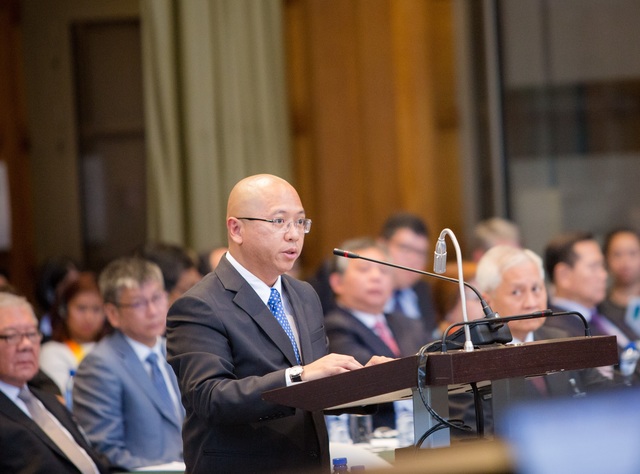
TOP DIPLOMAT. Philippine Foreign Secretary Albert del Rosario delivers an opening statement. Photo courtesy of PCA

Null

IN SESSION. Early on, the arbitral tribunal in The Hague decides to hold the hearings behind closed doors. Photo courtesy of PCA

Null

TOP GOVERNMENT LAWYER. Philippine Solicitor General Florin Hilbay, who serves as agent for his country, delivers a statement. Photo courtesy of PCA

Null

TEAM OF EXPERTS. The counsel team for the Philippines, including Professor Bernard Oxman, Professor Alan Boyle, and Mr Lawrence Martin, in the closed-door hearings. Photo courtesy of PCA

Null

HISTORIC CASE. The arbitral tribunal in The Hague, Netherlands, listens to the first country that brought China to court over the West Philippine Sea (South China Sea). Photo courtesy of PCA

Null

'GIANT SLAYER.' Internationally acclaimed lawyer Paul Reichler, the Philippines' chief counsel, delivers a statement. Photo courtesy of PCA

Null

REPRESENTING GOVERNMENT. Members of the Philippine delegation, including Justice Secretary Leila de Lima, Supreme Court Senior Associate Justice Antonio Carpio, and Deputy Executive Secretary for Legal Affairs Menardo Guevarra. Photo courtesy of PCA

Null

OBSERVER DELEGATIONS. The tribunal allowed observers from the following countries – Vietnam, Malaysia, Indonesia, Thailand, and Japan – to attend the hearings. Photo courtesy of PCA

Null

HIGH-CALIBER TRIBUNAL. The arbitral tribunal is led by Judge Thomas Mensah (president, C), the first president of the International Tribunal for the Law of the Sea. The high-caliber tribunal also includes the following (L to R): Judge Jean-Pierre Cot, Judge Stanislaw Pawlak, Judge Rüdiger Wolfrum, and Professor Alfred H. A. Soons. Photo courtesy of PCA

Null

TEAM PHILIPPINES. Representing all 3 branches of Philippine government, the Philippine delegation comes in full force in The Hague. Photo courtesy of PCA

The 5-member tribunal said it "now enters its deliberations" on whether it has the right to hear the Philippines' case. It said it expects to rule on this matter "before the end of the year."

The tribunal said it "is conscious of its duty under the Rules of Procedure to conduct proceedings 'to avoid unnecessary delay and expense and to provide a fair and efficient process.'"

Once the tribunal decides it has jurisdiction over the case, the Philippines can already present the meat of its arguments. (READ: EXPLAINER: Philippines' 5 arguments vs China)

The Philippines said it expects a definitive ruling against China by 2016 – Rappler.com

Now it's the Philippines vs taiwan's INVASION in Kalayaan for Oils

Kalayaan, Province of Palawan, Philippines. Taiwan want's to start exploring oil inside Kalayaan Municipality of the Palawan Province.

Chinese in Taiwan are originally from mainland China who were defeated by the China's Communist group so they retreated down south and take over the Formosan Government in Taiwan as a base island for their dream to controll back the communist Mainland China under the Republic of China government.

As the Mainland China is controlled by the Communist group, Taiwan the Republic of China claimed back the Mainland China as their territory which now both Mainland China and Taiwan are claiming each other.

Chinese in Taiwan are of the same ideology as all other Chinese in the world with the chinese in the mainland China.

With the continuous mounting of conflicts in the West Philippines Sea as a result of china's continuous expansionism affecting the Kalayaan Municipality of the Palawan Province in the Southwestern Philippines, taiwan jumps in of the same purpose as china to invade the Philippine territory.

The Kalayaan Municipality in the Kalayaaan Group of Islands is adjacent to the mainland Palawan Island and is part of the Province of Palawan which is within the 370 kilometers or 200 Nautical Miles Exclusive Economic Zone of the Philippines as granted by the United Nations' UNCLOS.

The now such called Kalayaan Group of Islands was once part of the old Sultanate of Sulu, a kingdom that exist and controlled the territory we back 12th to 15th Century. The old Sultanate of Sulu governed the Palawan Province, the now called Kalayaan Group of Islands or Spratly Islands in the West Philippines Sea together with several provinces in Mindanao Island such as the Province of Maguindanao, Lanao del Norte and Lanao del Sur, Zamboanga Peninsula, Basilan, Sulu, Tawi-tawi, and North Borneo (now called Sabah); before the invasion of Spain to the Philippines.

The Only country which has the rights and authority over the Spratly Islands or Kalayaan Group of Islands is the Philippines as the original territorial owner which was the old Sultanate of Sulu through Sultan Kiram has turned over his rights to the Philippine Government.

While the Philippines bracing from the China's invasion in the territory, there's another conflict is brewing in the West Philippine Sea, this time between the Philippines and Taiwan over oil and gas exploration around Ligao Island, the largest islet in the Spratlys group as reported by the INQUIRER Global Nation 30th December 2012.

The Philippine government on Saturday asserted its sovereign right to "explore and exploit" resources in the country's exclusive economic zone (EEZ) in the West Philippine Sea (South China Sea) as Taiwan announced plans to begin looking for oil and gas in  disputed areas of the Spratlys islands chain.

Assistant Secretary Raul Hernandez, the Department of Foreign Affairs (DFA) spokesperson, said Saturday that only the Philippines could explore in those parts of the Spratlys that lies within the country's 200-nautical mile continental shelf.

Reports from Taiwan said island nation's Bureau of Mines and state-run oil supplier CPC Corp. were keen on starting exploration for oil and gas in waters around Ligao Island, the largest Spratlys island that the Taiwanese call Taiping.

China, Vietnam and the Philippines have claims to Ligao Island.

The Philippines earlier this year offered oil exploration contracts in its claimed part of the Spratlys, a move that drew criticism from counter-claimants, especially China.

Without directly criticizing Taiwan for the move, Hernandez said foreign exploration within the Philippines' EEZ must be signed off by Manila in compliance with the United Nations Convention on the Law of the Sea (Unclos).

"The Philippines has exclusive sovereign rights to explore and exploit all types of resources in its continental shelf within the 200 nautical miles measured from the baselines in the western side of the Philippine archipelago," Hernandez said.

"No country can conduct oil exploration in the PH continental shelf in the West Philippine Sea without the permission of the government, as provided for under Unclos," he said.

Known to be dependent on oil imports, Taiwan is initiating the oil exploration to build up its oil resources, the reports said.

Taiwan's announcement came amid renewed tensions between China and the Philippines over reports of Chinese ships patrolling in the West Philippine Sea and plans to fortify Sansha City, an administrative domain established to govern all of the Spratlys.

The Philippines called both developments violations of international law and disrespectful of the Philippines' sovereign right to its EEZ.

China this week deployed an oceangoing ship in the disputed waters, the first time for a Chinese vessel to patrol beyond its coastal waters.  The patrol started ahead of the implementation of a new policing law allowing Hainan province's authorities to board and inspect foreign ships that will pass by the South China Sea, a critical international trading route.

Sources: INQUIRER Global Nation & the Spokesman of Sultan Kiram of the old Sultanate of Sulu

Philippine Navy sends first patrol ship to West Philippine Sea anew -beg China to respect its sovereign territory

China asked United States of America to respect its national interest in Asia; the Philippines asked China to respect its sovereign territory and it's 370 Kilometers from its coast or 200 Nautical Miles (NM) Exclusive Economic Zone as grants from UNCLOS: US will respect china's interest.

As published in the Business World Online Thursday, The Philippine Government once again calls for China to respect the "territorial sovereignty" and the exclusive economic zone after the former sent its first patrol ship to the West Philippine Sea (South China Sea), the Department of Foreign Affairs (DFA) said in a statement on Friday.

"The Philippines strongly objects to the Chinese patrol of Philippine maritime domain in the WPS [West Philippine Sea]," DFA Assistant Secretary and Spokesman Raul S. Hernandez said in a text message to reporters.

"Such patrol will not validate the 9-dash lines [China's claim] and is contrary to China's obligation under international law including UNCLOS [United Nations Convention on the Law of the Sea]," Mr. Hernandez added.

The government reacted to the reports that a patrol ship was sent from China in the disputed areas in the West Philippines Sea.

The dispute between the Philippines and China escalated after the Scarborough Shoal issue. Other countries such as Malaysia and Taiwan claim ownership of parts of the disputed seas. (read further in the Business World Online)

Philippines objections to new Chinese gunboat in the Spratly

MSN News also published that the  Philippines on Friday said it "strongly objects" to China's deployment of a new patrol vessel in the South China Sea, where the two countries have a seething maritime territorial dispute.

Such patrols will not boost China's claim to the disputed territory where the two countries have had a standoff since April, Department of Foreign Affairs spokesman Raul Hernandez said in a statement.

"The Philippines strongly objects to the Chinese patrol of Philippine maritime domain in the West Philippine Sea," the statement said, using the local name for the South China Sea.

It called on China to respect the country's "territorial sovereignty and EEZ", referring to the Philippines' 200-nautical-mile exclusive economic zone.

China's official Xinhua news agency said on Thursday an ocean-going patrol vessel equipped with a helipad would be deployed to the South China Sea, the first of its kind in the area.

In late November, China said it had granted its border patrol police the right to board and turn away foreign ships entering the disputed waters, raising fears of a confrontation.

Both the Philippines and China have overlapping claims over parts of the South China Sea, a major shipping route that is also believed to hold vast mineral resources.

Tensions between China and the Philippines have risen in the area since April after ships from both countries had a standoff over a rock outcropping known as the Scarborough Shoal.

While the Philippines has withdrawn its ships, it says China reneged on an agreement to pull out its own vessels.

China claims the shoal as well as nearly all of the South China Sea, even waters close to the coasts of neighbouring countries. The Philippines says the shoal is well within its EEZ. (read further in MSN News)

Philippines claims South China Sea islands, How Filipinos Discovered the Paradise in the Kalayaan Group of Islands?

Filipinos have settled on Thitu Island as a means to strengthen the country's claim on the Spratlys.

hitu Island is at the centre of one of the biggest territorial disputes in the world.

It is part of the Spratly Islands in the South China Sea, which are believed to be sitting on billions of dollars' worth of oil and gas reserves.

Six countries claim ownership of the tiny archipelago, including the Philippines, which has people living on Thitu Island as a means to strengthen its claim on the Spratlys.

Article published in Jazeera's Jamela Alindogan reports from the Spratlys in the West Philippine Sea (South China Sea).

Watch the Video of the Pagasa Island (Thitu Island) of the Paradise Kalayaan Group of Islands, Spratlys, Province of Palawan, (Old Sultanate of Sulu) Philippines.

World’s newest & stealthiest $3Billion USD destroyer will counter China in West Philippines


This file image released by Bath Iron Works shows a rendering of the DDG-1000 Zumwalt, the U.S. Navy's next-generation destroyer, which has been funded to be built at Bath Iron Works in Maine and at Northrop Grumman's shipyard in Pascagoula, Miss. (AP/Bath Iron Works)

A super-stealthy warship that could underpin the U.S. navy's China strategy will be able to sneak up on coastlines virtually undetected and pound targets with electromagnetic "railguns" right out of a sci-fi movie.

But at more than $3 billion a pop, critics say the new DDG-1000 destroyer sucks away funds that could be better used to bolster a thinly stretched conventional fleet. One outspoken admiral in China has scoffed that all it would take to sink the high-tech American ship is an armada of explosive-laden fishing boats.

With the first of the new ships set to be delivered in 2014, the stealth destroyer is being heavily promoted by the Pentagon as the most advanced destroyer in history -- a silver bullet of stealth. It has been called a perfect fit for what Washington now considers the most strategically important region in the world -- Asia and the Pacific.

Though it could come in handy elsewhere, like in the Gulf region, its ability to carry out missions both on the high seas and in shallows closer to shore is especially important in Asia because of the region's many island nations and China's long Pacific coast.

"With its stealth, incredibly capable sonar system, strike capability and lower manning requirements -- this is our future," Adm. Jonathan Greenert, chief of naval operations, said in April after visiting the shipyard in Maine where they are being built.

On a visit to a major regional security conference in Singapore that ended Sunday, U.S. Defense Secretary Leon Panetta said the Navy will be deploying 60 percent of its fleet worldwide to the Pacific by 2020, and though he didn't cite the stealth destroyers he said new high-tech ships will be a big part of its shift.

The DDG-1000 and other stealth destroyers of the Zumwalt class feature a wave-piercing hull that leaves almost no wake, electric drive propulsion and advanced sonar and missiles. They are longer and heavier than existing destroyers -- but will have half the crew because of automated systems and appear to be little more than a small fishing boat on enemy radar.

Down the road, the ship is to be equipped with an electromagnetic railgun, which uses a magnetic field and electric current to fire a projectile at several times the speed of sound.

But cost overruns and technical delays have left many defense experts wondering if the whole endeavor was too focused on futuristic technologies for its own good.

They point to the problem-ridden F-22 stealth jet fighter, which was hailed as the most advanced fighter ever built but was cut short because of prohibitive costs. Its successor, the F-35 Joint Strike Fighter, has swelled up into the most expensive procurement program in Defense Department history.

"Whether the Navy can afford to buy many DDG-1000s must be balanced against the need for over 300 surface ships to fulfill the various missions that confront it," said Dean Cheng, a China expert with the Heritage Foundation, a conservative research institute in Washington. "Buying hyperexpensive ships hurts that ability, but buying ships that can't do the job, or worse can't survive in the face of the enemy, is even more irresponsible."

The Navy says it's money well spent. The rise of China has been cited as the best reason for keeping the revolutionary ship afloat, although the specifics of where it will be deployed have yet to be announced. Navy officials also say the technologies developed for the ship will inevitably be used in other vessels in the decades ahead.

But the destroyers' $3.1 billion price tag, which is about twice the cost of the current destroyers and balloons to $7 billion each when research and development is added in, nearly sank it in Congress. Though the Navy originally wanted 32 of them, that was cut to 24, then seven.

Now, just three are in the works.

"Costs spiraled -- surprise, surprise -- and the program basically fell in on itself," said Richard Bitzinger, a security expert at Singapore's Nanyang Technological University. "The DDG-1000 was a nice idea for a new modernistic surface combatant, but it contained too many unproven, disruptive technologies."

The U.S. Defense Department is concerned that China is modernizing its navy with a near-term goal of stopping or delaying U.S. intervention in conflicts over disputed territory in the South China Sea or involving Taiwan, which China considers a renegade province.

China is now working on building up a credible aircraft carrier capability and developing missiles and submarines that could deny American ships access to crucial sea lanes.

The U.S. has a big advantage on the high seas, but improvements in China's navy could make it harder for U.S. ships to fight in shallower waters, called littorals. The stealth destroyers designed to do both. In the meantime, the Navy will begin deploying smaller Littoral Combat Ships to Singapore later this year.

Officially, China has been quiet on the possible addition of the destroyers to Asian waters.

But Rear Adm. Zhang Zhaozhong, an outspoken commentator affiliated with China's National Defense University, scoffed at the hype surrounding the ship, saying that despite its high-tech design it could be overwhelmed by a swarm of fishing boats laden with explosives. If enough boats were mobilized some could get through to blow a hole in its hull, he said.

"It would be a goner," he said recently on state broadcaster CCTV's military channel.

Foxnews

Philippines & China Send Warship to Disputed Seas

The tensions is fueled again for China vs. Japan, Taiwan, Philippines, South Korea, Vietnam and ASEAN Nation

Breaking News: The Philippines has relaunched an U.S. Coast Guard Hamilton Cutter Class as its biggest and most modern warship to guard potentially oil-rich waters that are at the center of a dispute with China.

President Benigno Aquino III witnessed the commissioning of the 3,390-ton Philippine navy frigate BRP Gregorio del Pilar in an austere ceremony Wednesday (December 14, 2011)  that he said symbolized his country's struggle to modernize its underfunded military despite many obstacles.

Aquino said the Philippines cannot guard its territorial waters and islands "with dilapidated vessels and old and faulty equipment."

The newly repainted warship can carry a surveillance helicopter and is mounted with anti-aircraft guns. The navy says it will be deployed near contested waters in the South China Sea.

China sends patrol ship to disputed waters

China has sent its largest patrol ship to the East China Sea to guard the country's territorial rights, state media said Wednesday (December 14, 2011), in a move likely to fuel tensions over the disputed waters.

China has repeatedly locked horns with its neighbors Japan and Taiwan over a group of uninhabited islands -- called Senkaku in Japan and Diaoyu in Chinese -- which Beijing claims are in its territorial waters.

Japan and Taiwan also claim sovereignty over the area, which is believed to be rich in oil and gas.

The 3,000-tonne Haijian 50 began its maiden voyage on Tuesday, the Global Times reported, citing the head of the East China Sea branch of the country's marine law enforcement agency.

The vessel will visit Rixiang Rock, Suyan Rock and the offshore oil and gas fields of Chunxiao and Pinghu, as well as China-Japan joint development zones, Liu Zhendong was quoted saying.

The Chinese-made vessel is equipped with the country's "most advanced marine technology and is capable of accommodating China's Z9A helicopters", the report said.

It will conduct joint patrols with the Haijian 66, a 1,350-tonne ship deployed in March.

Disputes over the East China Sea and South China Sea have intensified recently, with Chinese President Hu Jintao earlier this month urging the navy to prepare for military combat and a US campaign to assert itself as a Pacific power.

Several Asian nations have competing claims over parts of the South China Sea, believed to encompass huge oil and gas reserves, while China claims it all.

Separately, Beijing and Seoul are involved in a dispute over the Yellow Sea, where a South Korean coastguard was stabbed to death by a Chinese fisherman this week.

Taiwan will deploy missile in Spratlys downplayed by the Philippines but Sultanate State of Sulu worried

Itu Aba Island (Taiwan: Taiping Island (Chinese: 太平島; pinyin: Tàipíng Dǎo; Vietnamese: Đảo Ba Bình; Filipino: Ligaw/Ligao), is the largest of the Spratly Islands in the South China Sea and the only island with a freshwater supply. The island is elliptical in shape being 1.4 km in length and 0.4 km in width. It is part of the Tizard Bank (Zheng He Reefs), one of seven reefs in the Spratly Islands near the centre of the West Philippines Sea (South China Sea)

Taiwan's defense minister has backed a plan to deploy advanced missiles in the island Itu Aba (Taiwan: Taiping, Filipino: Ligao-Ligao, Vietnamese: Đo Ba Bình) in Spratlys over concerns that rival claimants to disputed islands are building up their arms, a legislator said Thursday.

Kao Hua-chu endorsed a proposal passed by the country's defense committee Wednesday (October 12, 2011) demanding coastguard units in Itu Aba (Taiping) and the Pratas islands -- claimed by China - be armed with Chaparral or Tien Chien I missiles.

"Minister Kao made it clear that he supports the proposal," he was quoted as saying in a statement released by Lin Yu-fang, the legislator from the ruling Kuomintang who pushed for the deployment.

Philippines defense department spokesman Zosimo Jesus Paredes said the country enjoyed good relations with Taiwan and believed its plan to supply missiles to coastguard units in the areas it claims was not a threat to the Philippines.

"We cannot dictate on Taiwan on what or what not to do," However, he said Manila was prepared to "defend to the hilt" islets it has already occupied in the Spraltys.

But when asked whether Manila considered a move towards aggression, he said: "Not really… we should not be over reactive."

However, the lobbying of power the Sultan of the Sultanate State of Sulu and North Borneo; Sultan Kiram is worry of this as he believed that the whole Spratlys is belong to his territory and under his sovereignty and belong to his people majority the Muslim people in Southern Philippines and Sultanate State of Sulu and North Borneo (Sabah).

Sultan Kiram revived his claim and challenged the Philippines government Saturday (October 15, 2011) to support them to take-over the North Borneo (Sabah) from Malaysia which is links to the islands of Palawan and the Spratlys Archipelago.

Sultan Kiram reminded the Philippines that the North Borneo (Sabah) is belong to the Sultanate State of Sulu and Borneo that links Palawan islands and Spratlys Archipelago which rightful owner is the Filipino people after turning-over his rights to the Philippines government in 1967.

He reminded also the majority Christian Filipinos that the North Borneo which is called now as Sabah by Malaysia was illegally captured by Britain and give it to Malaysia without his approval.

Taking-over back North Borneo (Sabah) will give more chance to the Philippines and the Sultanate State of Sulu to control the islands in the Spratlys – Kalayaan Island Group and the southern part of Palawan islands which is also claimed by Kuala Lumpur.

The deployment of advance missile by Taiwan triggered concern to the Sultan of the Sultanate state of Sulu as it is considered as belligerent action of Taiwan might triggers conflict and unwanted war  in his territory in the spratlys.

Apparently mindful of rising regional tensions, Kao said the Taiwanese coastguards may need advanced weaponry rather than the Chaparral which Taiwan first acquired in the 1980s.

"Perhaps Tien Chien I or more advanced air defense missile systems should be given priority since the Chaparral is pretty old," Kao said.

The plan came following a report in July which found that Taiwan's coastguards in the contested waters were vulnerable amid mounting tensions.

Taiwan, Vietnam, Brunei, China, Malaysia, and the Philippines claim all or part of the Spratlys, which could lie on top of large oil reserves.

The Taiwanese coastguard currently has a 130-strong garrison on Itu Iba island (Taiping), the biggest island in the Spratlys archipelago.

Lin said the proposed ground-to-air missile deployment would be legitimate, citing the ministry's recent report on the military buildups by Vietnam and other neighboring countries in the area.

Vietnam has deployed thousands of marines in the zone, backed Russia-made Su-27SK and Su-30MK2 fighter jets; Lin cited the report as saying.

"In stark contrast, the Taiwanese coastguards are only equipped with 20-mm air defense guns," he said in a statement.

The defense ministry added that in case of military conflicts, Taiwanese coastguards could hardly defend themselves against the Philippine forces equipped with naval gunboats, Lin added

The Philippines said Sunday it was prepared to defend its claims in the South China Sea, but downplayed a plan by Taiwan to deploy missiles in the area

Paredes stressed the government still believed in pursuing a peaceful solution, but stressed Taiwan's move might be misunderstood by some claimants as provocative.

He said Taiwan's move could be seen as "unsettling" by other claimants to the area, stressing that it should have officially informed them of its plan so as not to escalate tensions.

"I think moves like these should be coordinated (with other claimants) so that we will not be taken aback," he said.

On the other hand, the neighboring countries surrounding Taiwan and Hainan China is on the hand to support the Philippines of its Spratlys claim. Australia and Japan pronounced their support to the Philippines which later the New Zealand followed.

USA as the most powerful ally of the Philippines turnover its Hamilton Class cutter warship to the Philippines to boost its naval patrol in the Spartlys and recently but not yet confirmed by our team, the South Korea will offer also a navy patrol boat to the Philippines to be use in patrolling in the West Philippines Sea (South China Sea).

To follow more consolidate and contributed issues about the Spratlys join the Hikot's Spratlys Page.

Vietnam side by side Philippines - China disputed sea Row

Vietnam signed with the Philippines

The Philippines and Vietnam have agreed to protect the delicate marine ecosystem in the West Philippine Sea from threats of overexploitation, the Department of Foreign Affairs (DFA) said.

The DFA said the agreement was made to address illegal, unregulated and unreported fishing in accordance with the national laws of both countries.

Senior officials of both countries also endorsed the enhancement of cooperation on maritime and ocean matters. This includes the elevation of the Joint Permanent Working Group on Maritime and Ocean Concerns into a vice ministerial level, continued support for the Joint Oceanographic and Marine Scientific Research in the South China Sea, and implementation of the Memorandum of Agreement on Oil Spill Preparedness and the MOA on Search and Rescue at Sea.

The Philippines is also worry of any possible damage that would greatly affect the Philippines Marine Ecosystem as the Spratlys sea bed is link and inter connected with the Philippines and the area is just very close to the country than the other claimants.

The Philippines is also aware of any unwanted oil spills in the sea will closely affect the Palawan seas as the area is just few kilometers away and the Spratlys  is within Philippines' proximity.

The Philippines and Vietnam are claimants to the potentially oil-rich waters and land features of West Philippine Sea.

The DFA said the Philippines and Vietnam agreed to speed up implementation of the MOA on Defense Cooperation and the MOA on Academic Cooperation as 11 areas of cooperation were reviewed.

"This is more than a wish list. It is a commitment to steer Philippines-Vietnam relations towards a more meaningful and deeper cooperation," Foreign Affairs Secretary Albert del Rosario said.

Del Rosario acknowledged the 11 areas of cooperation reviewed by senior officials of both countries at the 6th Philippines-Vietnam Joint Commission for Bilateral Cooperation held in Hanoi on Oct. 6 and 7 2011.

The MOA on Defense Cooperation and the MOA on Academic Cooperation were signed last year.

This year, the Philippines and Vietnam are celebrating the 35th anniversary of diplomatic relations.

Since the last Joint Commission for Bilateral Cooperation in 2008, the two countries worked together on a number of areas such as political cooperation, defense and security, trade and investments, maritime and ocean concerns, agriculture, energy, tourism, education and culture.

Del Rosario and Vietnamese Foreign Minister Pham Binh Minh highlighted the official exchanges that continue to give impetus to the bilateral relations, notably the positive outcomes of the visit to Vietnam by President Aquino in October 2010 and the forthcoming visit of President Truong Tang to the Philippines later this month.

An action plan for 2011-2016 is expected to be launched during President Tang's visit to drive the cooperation to a comprehensive and solid partnership.

China and Vietnam sign agreement to cool sea dispute

China and Vietnam signed an agreement seeking to contain a dispute over the South China Sea that has stoked tensions between the two Communist-ruled neighbors divided by a history of distrust, China's official news agency said on Wednesday.

Diplomats signed the six-point agreement on Tuesday (October 11, 2011), while the General Secretary of the Vietnamese Communist Party, Nguyen Phu Trong, held conciliatory talks with Hu Jintao, who is China's Communist Party chief and president.

Vietnam and China, the Philippines - as well as, Brunei, Malaysia and Taiwan - stake conflicting claims of sovereignty over parts of the South China Sea, a potentially oil and gas rich body of water spanned by key shipping lanes.

Under the deal that builds on Beijing's efforts to cool tensions over rival territorial claims in the South China Sea, the two sides agreed to open a hotline to deal with potential maritime flare-ups and hold border negotiation talks twice a year.

"The two countries should remain committed to friendly consultations in order to properly handle maritime issues and make the South China Sea a sea of peace, friendship and cooperation," said the agreement, according to China's Xinhua news agency.

"Both sides should solve maritime disputes through negotiations and friendly consultations."

The bridge-building effort could dispel some of the rancour that has built up in the region, setting Beijing against Southeast Asian nations that have turned to the United States to counter growing Chinese military and political influence.

Last month, China's top official newspaper warned that a joint energy project between India and Vietnam in the sea infringed China's territorial claims.

In May and June, Vietnam accused Chinese vessels of harassing Vietnamese ships within Vietnam's exclusive economic zone. China denied its ships had done anything wrong.

Businessmen and diplomats say China has pressured foreign firms in deals with Vietnam not to develop oil blocks in the sea.

China helped Vietnamese Communist forces to victory in their decades-long fight against U.S. backed forces, but the two Asian nations have a history of mutual distrust reflecting Vietnam's anxieties about its much bigger neighbor. In 1979, they fought a short but bitter border war.

On the day that the agreement was signed, China's President Hu told Vietnam's party chief Trong their two countries should try to get along.

Inspite of the Philippines leading for the Unity for the ASEAN to solve the Spratlys disputes; China still insist for 1 on 1 resolution and refused the challenge of the Philippines to bring the issue to the United Nations ITLOS. 

2 laws - UNLCOS 200 NMEEZ and "Archipelagic States" to End Spratlys Disputes

The following Countries competing to owned the vast oil and gas resource Spratlys: The Philippines, Brunei, Vietnam, China, Taiwan (China), Indonesia, Malaysia.

Written by: Dan We ( Twitter: @Dan_We_)

NO ONE IS ABOVE THE LAW...

The most powerful country – the USA is under the LAW and they governed their states and country UNDER THE LAW

CHINA is NOT ABOVE THE LAW... China govern their people under their communist law

The fueling disputes in the West Philippines Sea (WPS) or also called as South China Sea (SCS) might be the flash point which leads to the never ever wanted 3rd World War. (WWIII)

No one ever wants to have their people die from war and conflicts. The good leader must learn how to respect and be respected. A good leader must know how to lower his pride to avoid tensions. A good leader must learn that there is a doom beyond their unlimited pride and ambition to rule the world by their arms.

China has been so confident to replace the US power but their move is not in the right direction. China could bully small neighbors economically but not by arms because small ants are willing to bite and eat the dragon’s flesh if their colony is destroyed and overtaken. Small ants could be worthless but could weaken the dragons power while another giants will come to the rescue and to end the dragons ambition.

China must first plant a good seeds of trust; seeds of unity, seeds of love and seeds of power and wait that those planted seeds would grow and bear fruits for what they have planted for them to overtake other power. It’s early for china to say they are powerful if the whole countries around them are against their power. Unlike US, China never planted any seeds and wants to reap the fruit of the other peasant.

The bottom-line is china would live alone if they will make the unwanted stupid mistake. Any wrong move of china could ends its power both arm and economy. Any wrong move of china will trigger the world to fight against them lead by the US Power, United Nations and the ASEAN nations.

China must have to think that among top 10 Super powers of the World; they got only 1 friend to fight with the other 8.  2 super powers versus 8 super powers is the doom’s day of China and his 1 ally. Who will take over china’s power if they are in the doom’s day? Korea? Vietnam? Russia? India? Mongolia? USA? or Japan?

China! Look before you leap and think before you talk. You must learn how to grow in a peaceful way. You must learn how to get along with other country’s culture than just yours. And you must follow the 2 laws that would end the disputes of the seas.

2- Laws of the United Nations to end the Spratlys disputes.

The first provision of law applicable to the disputed Spratlys is the law formulated by the United Nations in Jamaica last December 10, 1982. The provision for the Archipelagic States.

(1.)           THE ARCHIPELAGIC STATES

The Philippines and four other states (Indonesia, Papua New Guinea, Fiji and Bahamas) got the approval in the UN Convention on the Law of the Sea (UNCLOS) held in Jamaica last December 10, 1982. They were qualified as archipelagic states.

In various conferences of the United Nations on the Law of the Sea (UNCLOS), the Philippines which is composed of 7,107 islands PLUS... is RECOGNIZED AS ARCHIPELAGIC STATES given freedom forming its archipelago that  composed of groups of islands forming a state as a single unit, with the islands and the waters within the baselines as internal waters. By this concept (archipelagic doctrine), an archipelago shall be regarded as a single unit, so that the waters around, between, and connecting the islands of the archipelago, irrespective of their “breadth and dimensions”, form part of the internal waters of the state, subject to its exclusive sovereignty

The approval of the United Nations for the 5 countries as Archipelagic States must be respected by the world for the 5 countries:

1.      The Philippines

2.      Indonesia

3.      Papua New Guinea

4.      Fiji

5.      Bahamas

The  above mentioned countries could enjoy undisputable sovereignty of the waters and islands around them from the said laws. Waters around their country between and connecting the islands of the archipelago, irrespective of their breadth and dimension form part of the internal waters of the states and is belong to its sovereignty. This provision of the UNCLOS is very clear that this law could end the disputes of the Spratlys. The United Nations could not formulate again another provision that would opposed the above “Archipelagic State”.

For the Philippines – The Spratlys is considered as the waters around the Philippines between and connecting the islands of the archipelago, irrespective of their breadth and dimension form part of the internal waters of the states which simply means Spratlys is part of the Philippines sovereignty and the Philippines don’t have any disputable issues between china and other countries who are not classified as “Archipelagic States”.

(2.)          The United Nations Conventions of the law of Sea (UNCLOS) 200 Nautical Miles Exclusive Economic Zone

The 200 Nautical Miles Exclusive Economic Zone is another provision of the law by the UNCLOS that could resolve the Spratlys disputes.

Regardless of what kind of law of china have for its country is not acceptable in the international law would deem that their law is invalid and must be superseded by the United Nations Law that for the particular disputes that would affect many countries around them.

For the following Countries competing to owned the vast oil and gas resource Spratlys:

1.      The Philippines

2.      Brunei

3.      Vietnam

4.      China

5.      Taiwan (China)

6.      Indonesia

7.      Malaysia

The 7 countries mentioned above competing claims have their common grounds which is the UNCLOS 200 Nautical Miles Exclusive Economic Zone. Each country might have to study first if their claim is valid or not.

For the Philippines; 2 provision of laws that would protect them to own the Spratlys exclusively with undisputable sovereignty by the application of the “Archipelagic States” that say the waters around the Philippines between and connecting the islands of the archipelago, irrespective of their breadth and dimension form part of the internal waters of the states which simply means Spratlys is part of the Philippines sovereignty and the Philippines don’t have any disputable issues between china and other countries who are not classified as “Archipelagic States”.

Secondly the Philippines still subject to enjoy the second provision of laws of the United Nations Conventions Laws of the Sea (UNCLOS) 200 Nautical Miles Exclusive Economic Zone. Since most part of the Spratlys is within 200 Nautical Miles Economic Zone of the Country then Majority stakes for the Spratlys sovereignty is lawful to be granted to the Philippines. “Proximity” the Spratlys is just within Philippines backyard.

The application of the 2 provisions of laws of the United Nations Convention of the Laws of Sea (UNCLOS) the  “Archipelagic States” and the “200 Nautical Miles Exclusive Economic Zone” means the “Whole Spratlys” is under the Philippines Sovereignty and the Philippines supposed to be must enjoy their undisputed territory in both their main land and the Spratlys.

The Paracels is another disputed islands between Vietnam and China which both of them could benefit the 200 Nautical Miles Exclusive Economic Zone must send the disputes to the United Nations and they will signed an agreement to solve the disputes peacefully. The United Nations also must mediate and implement the law to end the disputes.

WHAT MUST CHINA DO? (AN SO ORDER!)

1.       China must respect Vietnam’s territory and 200 Nautical Miles Exclusive Economic Zone from Vietnam Shore (The Paracel Conflict between China and Vietnam) and vice versa, Vietnam must respect also the China’s 200 Nautical Miles Exclusive Economic Zone.

2.       China must stop disputing with the Philippines as the Philippines is recognized by the United Nations as Archipelagic States which means water and islands  connecting the Philippines regardless of its breadth is belong to the Philippines sovereignty.

3.       China must settle the disputes with Vietnam in the United Nations and respect the UNCLOS 200 Nautical Miles Exclusive Economic Zone.

Japan & Philippines Tighten Defense Ties Sea disputes

Bolstering defense Japan - Philippines

Japan and the Philippines agreed on during the visit of the Philippines' president to Japan September 27, 2011 to strengthen maritime security ties, while also underscoring the importance of preserving peace and stability in the West Philippines Sea (South China Sea) amid rising tensions with China.

China has pronounced many times that they owned everything the in West Philippines Sea that worries other tiger economies in Asia such as Japan & South Korea which major of their trades are passing the world's most busiest sea in the West Philippines Sea and South China Sea – Spratlys archipelago.

Prime Minister Yoshihiko Noda and the Philippines President Benigno Aquino III met, on a four-day visit to Japan. Japanese Prime Minister told reporters that the two sides committed to bolstering "cooperation between coastguards and defense-related authorities."

A joint statement said bilateral ties have evolved from friendly relations to a "strategic partnership," and called for more collaboration on "regional and global issues of mutual concern and interest." The two countries also agreed to conduct frequent discussions on defense at more senior levels and increase the number of Japan Coast Guard missions to help train their Philippines counterparts.

Although the agreement does not directly mention China, it is a major symbolic step toward a multilateral consensus in Asia on dealing with increasing territorial friction with China.

China maintain its claim to the whole West Philippines Sea & South China Sea  with its 9 dotted map inspite of criticism of the ASEAN neighbor with 200 Nautical Miles Exclusive Economic Zone claim in the sea.

The Philippines and China both lay claim to the Spratly Islands; an archipelago in the West Philippines Sea and South China Sea that geologists think may lie atop significant oil and gas deposits and rumored to be the 4th largest oil and gas deposit in the world. Philippines' officials have accused Chinese vessels of hindering oil and gas exploration in a portion of the waters known as Recto Bank (Reed Bank) which is just few kilometers off Palawan Province – Philippines says this is not part of the disputed areas. Vietnam, which also claims part of the Spratly chain, has likewise complained of China's increasingly assertive claims in the region.

China's Fishing Vessel tactics

China has been noticed by the neighbors that they are using fishing vessel tactics which equipped with high powered weapon to enter other waters. Japan learned from China's tactic after China invaded the Mischief Reef few kilometers off Palawan province of the Philippines using the fishermen vessel to erect a fishermen shelter then later converted it into a Military Garrison even inside the Philippines territory.

In 2011 alone, Japan intercepted Chinese Fishing vessel entering their waters. Moreover, Indonesia's coastguard also arrested Chinese entering their seas using a fishing vessel.

The recent issue that escalate tension between Vietnam and China happened also this year when Chinese fishing vessel cut the cable of the Petro Vietnam, a Vietnam Government Owned Oil exploration which china alibi as it is just a Chinese Fishing vessel and mistakenly drag the cable but later admitted that Vietnam is illegally operating in the area as they said its owned and they do not violated any law and they are not invading.

The Philippines didn't escape from China's harassment. China harassed Filipino Fishermen in the Philippines Waters saying to leave the area because it belongs to china, then another incident happened when China fired the Filipino Fishermen in the Palawan Sea and put markers in the Island and waters in Palawan shore.

Japan too, has seen its relations with China strained by a territorial dispute, this one over islands in the East China Sea. A war of words broke out between Beijing and Tokyo last autumn following the arrest of a Chinese fishing crew by the Japanese coast guard, and the year since has brought a series of incursions by Chinese ships into the disputed waters. Mr. Noda earlier this month voiced concern over China's military build-up and increased maritime activity near Japan.

The agreement between Japan and the Philippines stresses the two countries' shared interests, bringing the similar but separate maritime squabbles with China under a larger cooperative umbrella.

"The peaceful settlement of disputes serves the interests of the two countries and the whole region," said the joint statement, signed by both leaders. Japan and the Philippines "share the recognition that these same interests should also be advanced and protected in the West Philippines Sea and South China Sea."

Responding to the Japan-Philippines meeting, China's foreign ministry on Tuesday (September 27, 2011) reiterated its claim to the disputed waters in the South China Sea.

"China has indisputable sovereignty over the island and surrounding waters of the South China Sea," said ministry spokesman Hong Lei in Beijing.

Regardless of many criticisms, China never leaves the phrases; "we owned everything" & "China has indisputable sovereignty over the island and surrounding waters". Philippines Challenged China to bring the disputes to the United Nations to end it but China refused and said we are only open to bilateral settlement not to the United Nations. 

Investment Recommendation: Bitcoin Investments

Live trading with Bitcoin through ETORO Trading platform would allow you to grow your $100 to $1,000 Dollars or more in just a day. Just learn how to trade and enjoy the windfall of profits. Take note, Bitcoin is more expensive than Gold now.


Where to buy Bitcoins?

For Philippine customers: You could buy Bitcoin Online at Coins.ph
For outside the Philippines customers  may buy Bitcoins online at Coinbase.com